'Dance around the maypole', by the 16th century Flemish artist Pieter Brueghel the Younger. Image credit: Wikipedia
You
can read in this article about someone whom Roger Conant would probably have heard about and possibly may have met. This was the adventurer and colonist Thomas Morton whose liking for the tradition of dancing around maypoles brought him into conflict
with the separatist Plymouth Puritans who sailed to America on the 'Mayflower' in 1620.
Morton would have
been delighted to know that children in the Devon village of East
Budleigh, birthplace of Roger Conant, maintain the tradition on May Day.
In All Saints’ Church, East Budleigh, with the painting ‘Blessed are the Peacemakers’: (l-r) Rev Martin Jacques, Professor Stan Roberts, the artist John Washington, Michael Downes. Photo credit: Peter Bowler
Earlier this year, on 1 August, I
was invited along with artist John Washington to give a talk about John’s
wonderful painting of Roger Conant’s 1625 encounter with the Plymouth Puritans’
military officer Myles Standish - shown in the foreground on the right - on Fisherman’s Field, in Gloucester,
Massachusetts.
John and I mentioned Standish as ‘short of stature’. We should of course have referred to him
as ‘Captain Shrimp’. This was the colourful and better known epithet famously bestowed
on Standish by Thomas Morton.
Like Roger Conant, Morton has made a name for himself in Massachusetts,
and further afield in the USA. However he was very different in character from the
East Budleigh-born pioneer associated with the city of Salem.
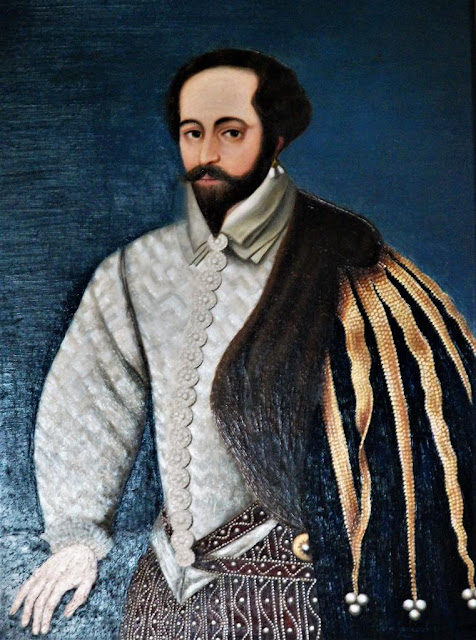
A copy of one of the best
known portraits of Sir Walter Ralegh, formerly attributed to Zuccaro but now to
the monogrammist 'H' (? Hubbard) and dated 1588. Displayed in All Saints’
Church, East Budleigh, it shows Ralegh in court dress at the height of his
favour with Queen Elizabeth I. Ralegh had been appointed Captain of the Guard the
previous year
Although supposedly Devon-born, Morton is barely known in
this county. But he cuts a complex and flamboyant figure in the story of
America. I’ve been struck by the ways in which he resembles East Budleigh’s more
famous son Sir Walter Ralegh. This is in contrast to Roger Conant, who was described
by his biographer Clifford Hampton as ‘meticulously honest’ and ‘self-effacing’.
Both Ralegh and Morton were poets of course. In fact Dr Jack
Dempsey, historian and editor
of Morton’s work, believes that this early colonist can also claim to be America’s first poet in English.
The title page of Ralegh’s Discovery of Guiana, showing the Ewaipanoma, or people 'without heads'. This edition was published by
Hulsius Levin in Nuremberg, 1599. Image credit: www.historycollection.com
Morton achieved celebrity status in England, partly as a
result of writing a book about the exciting discoveries that he had made in the
New World. Ralegh similarly, shortly after his 1595 voyage to South
America, had published his ‘Discovery
of the large, rich, and beautiful Empire of Guiana’.
Ralegh's book had created a
sensation when it appeared in 1596, with its suggestions of the treasure to be
found in places like ‘the great and golden city’ known to the Spanish as ‘El
Dorado’. Equally fascinating for some readers was the author's mention of extraordinary peoples such as the Ewaipanoma,
described by the explorer as ‘without heads’.
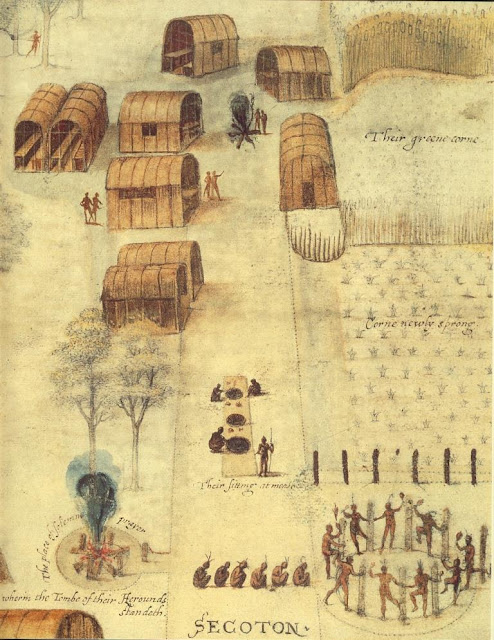
A watercolour by John White depicting a village of the Secotan Indians in North Carolina. Image credit: Wikipedia
An earlier publication backed by Ralegh and composed by his friend and tutor,
the scientist Thomas Harriot, was 'A Briefe and True Report of the New Found
Land of Virginia' which appeared in 1588.
The publisher
Theodor de Bry issued a new, illustrated edition in 1590, and it is notable for
the remarkable watercolours depicting life in America, including portraits of
Native Americans.
Watercolour by John White of dancing Secotan Indians in North Carolina. Image credit: Wikipedia
They were painted by John White, who along with Harriot had
been sent by Ralegh as artist and mapmaker for Sir Richard Grenville’s 1585
expedition to the New World. The collection of White’s paintings is one of the
treasures of the British Museum. You can see more of them at https://raleigh400.blogspot.com/2018/11/the-watercolours-of-john-white-artist.html
‘Come to this
place where everything is neat and tidy and there is food everywhere!’ is the
message of John White’s watercolours according to the American author and
science historian Deborah Harkness.
Thomas Morton’s ‘New English Canaan’, first published in 1637, as shown above, aimed similarly to promote the New World to Europeans. The American statesman John
Adams, in an 1812 letter to Thomas Jefferson, described Morton as wishing ‘to Spread
the fame and exaggerate the Advantages of New England’.
Coincidentally, early on in his
career, Morton found employment with a friend of Sir Walter Ralegh. This was Sir
Ferdinando Gorges, governor of the English port of Plymouth, who had many
commercial interests in New England and who would found the colony of Maine.
'The
School of the Night' by Ronnie Heeps, painted in 2006. © the artist. Photo credit: Jersey Heritage
Despite being one of Queen Elizabeth I’s favourite courtiers,
Ralegh managed to alienate many members of the Establishment who viewed him and
his friends with suspicion, particularly with regard to religion. This fine painting by the Scottish artist Ronnie
Heeps is based on the notion that Ralegh was the central figure in a group
known by the modern name of ‘The School of Night’. The group supposedly
included poets and scientists Christopher Marlowe, George Chapman, Matthew
Roydon and Thomas Harriot.
There is no firm evidence that
all of these men were known to each other, but speculation about their connections
features prominently in some writing about the Elizabethan era.
In 1592, following Elizabeth’s proclamation against the
Jesuits, the rumour of Ralegh’s supposed atheism was spread by Father Robert Parsons,
in a document published in response to the royal edict. There was a reference
to ‘Sir Walter Ralegh’s school of atheism’ with its supposed ‘diligence used to
get young gentlemen to this school, wherein both Moses and our Savior, the Old
and New Testament are jested at, and the scholars taught among other things to
spell God backward’.
Fr Parsons’ accusation was of course simply Catholic propaganda,
but Ralegh’s enemies were quick to take advantage of it.
A commission was set up in 1594 at Cerne Abbas,
close to his home at Sherborne Castle, to deal with accusations that Ralegh and
his circle of intellectual friends had denied the reality of heaven and
hell. He was acquitted, but the accusation
of atheism was again raised at his trial for treason in 1603. It is likely that
this contributed to the guilty verdict reached by the court, a verdict which made
Ralegh’s death sentence inevitable after the failed 1617 expedition to Guiana.
A conjectural
image of Governor William Bradford, produced as a postcard in 1904 by A.S. Burbank
of Plymouth, together with the front page of Bradford’s Journal. Image credit:
Wikipedia
Curiously, identical words were used by Thomas Morton’s enemies
when the same accusation was levelled against him in America half a century
later. In his memoirs, the separatist Puritan William Bradford (1588-1657), governor of Plymouth colony, villified Morton as a ‘lord of misrule’ who ‘maintained (as it were) a schoole
of Athisme’.
Portrait of
Nathaniel Hawthorne by the Salem artist Charles Osgood, together with a page of
‘The May-Pole of Merry Mount’, as it was first published in 1836
The account of Thomas Morton’s downfall at the hands of Myles
Standish and the separatist Puritans of the New England Plymouth Colony is well
known partly because of Nathaniel Hawthorne’s ‘The May-Pole of Merry Mount’. This short work was
first published in 1836 before being included the following year in a collection
published by the Salem-born author entitled Twice-Told Tales.
Thomas Morton is said to have been born in Devon
around 1579, and that assumption has given rise to the theory that the land of
his birth influenced his supposed paganism and accounted for his dislike of Puritans.
‘Devon denotes “people of the land” with life-ways
different from those of the urbanized East,’ writes Dr Jack Dempsey, pointing out
that Devon’s men and women liked their traditional independence, which was
why many in the county had taken part in the 1549 Western Rebellion. ‘As time
passed, frustrated Protestant “reformers” called the West Country a “dark corner
of the land”’.
Many areas of the West Country were doubtless
conservative and traditional in outlook, but Protestant theologians like Myles
Coverdale, translator of the Bible and for a short time, Bishop of Exeter, must
have had some success in persuading Devonians to welcome the Reformation. Some,
like Sir Walter Ralegh’s parents in East Budleigh in the 1550s, would have seen
that supporting the Reformation made political sense during the monarchies of Edward
VI and Elizabeth I. By 1685, far from being reluctant to embrace the new
religion, the South-West of England was a strongly Protestant region, prompting
the Duke of Monmouth to choose Lyme Regis in Dorset as a landing point to start
his ill-fated Rebellion.
The statue of William III, who landed in
Brixham on 5th November 1688. Image credit: Steve Daniels, Wikipedia
Three years later, the Protestant William of
Orange chose Brixham in Devon to launch the ‘Glorious Revolution’ of 1688 and
overthrow the Catholic king James II.
The doorway of Clifford’s Inn, London. Image credit: Wikipedia
We
have no hard evidence of where Thomas Morton was brought up in Devon, but it seems
that he received a sufficiently good education to pursue law studies at Clifford’s
Inn, one of the Inns of Court in London. Initially he worked for Sir Ferdinando Gorges in a legal
capacity in England, before overseeing the latter’s interests in the American colonies.
The separatist Puritans who sailed in the 'Mayflower' in 1620, frustrated by their failure to bring about reform within the Church of
England, had established their New England Plymouth Colony under their governor
William Bradford.
Morton is thought by some
historians to have spent an exploratory three months in America in 1622 before
returning to England the following year, complaining of intolerance in certain
elements of the Puritan community as indeed Roger Conant is said to have done.
Later,
in his book ‘The New English Canaan’, Morton described how in America he had encountered
“two sortes of people, the one Christians, the other Infidels; these I found
most full of humanity, and more friendly then the other.”
He returned in 1624 on the ship the ‘Unity’ with
his associate Captain Richard Wollaston and 30 indentured servants. They settled
on a site which they named Mount Wollaston in what is now Quincy, Massachusetts, and began trading for furs with Native Americans. The Plymouth Puritans soon objected when Morton and his associates began selling guns and liquor to the natives.
Morton’s partnership with Wollaston
ended in 1626 when he discovered that the latter had been selling their
indentured servants into slavery on the tobacco plantations of Virginia. Encouraged
by Morton, the remaining servants rebelled and organised themselves into a free
community, forcing Wollaston to flee to Virginia. Morton now became the
inspiration for what has been called an almost utopian project, with aims which
included a degree of integration into local Algonquian culture.
The seal
of the City of Quincy in the US state of Massachusetts, adopted in 1889. Image
credit: Wikimedia
The new settlement was renamed as
Ma-re Mount, literally ‘Hill by the Sea’, as shown on the seal of the City of Quincy,
but soon became known as Merry Mount. Morton angered the Puritans even more
when in 1627 he and his group held May Day festivities centered on a maypole.
For centuries, dancing around maypoles
had been traditional in much of Europe, but the rise of Protestantism in the
16th century led to increasing disapproval by religious reformers who viewed the
custom as idolatry and immoral.
In 1549, the vicar of St
Katharine Cree church at Aldgate in the City of London had preached a sermon
against 'pagan' maypoles from the open-air pulpit at nearby St Paul’s Cross.
The listeners were so fired up by what they heard that they pulled the maypole
down, cut it into pieces and then burned it.
Under the rule of Oliver Cromwell
and the Puritans in England, the Long Parliament's ordinance of 1644 described
maypoles as ‘a Heathenish vanity, generally abused to superstition and
wickedness'.
May Day at Merrymount: an illustration from 'A popular history of the United States, from the first discovery of the western hemisphere by the Northmen, to the end of the first century of the union of the states'. (1881) Image credit: Wikipedia
News of Morton’s May Day festivities infuriated the
Plymouth Puritans, especially as the Merry Mount colonists were evidently
encouraging sexual relations between Europeans and Native Americans. Governor William
Bradford, in his ‘History of Plimoth Plantation’, recorded his disgust on
learning that they had ‘set up a May-pole, drinking and dancing about it many
days together, inviting the Indian women for their consorts, dancing and
frisking together (like so many fairies, or furies rather) and worse practices’.
It was, he wrote, ‘as if they had anew revived & celebrated the feasts of
ye Roman Goddess Flora, or ye beastly practices of ye mad Bacchanalians’.
Additionally, the growing prosperity of Morton’s
Merry Mount colony was seen as threatening the Puritans’ trade monopoly.
Captain Myles Standish, as imagined by Budleigh
artist John Washington. Photo credit: Peter Bowler
When even more extravagant May Day celebrations around
an 80-foot maypole took place the following year a military offensive against the
colony was led in June 1628 by the Captain Myles Standish.
Sadly, on this occasion, there was no Roger Conant
to act as peacemaker between the two groups. Not that there was any serious
resistance from Morton and his companions, being as they were, in Governor
Bradford’s words, ‘over armed with drink’.
Thomas Morton of Merrymount arrested by Captain
Myles Standish of the Plymouth Colony, a book engraving by C. J. Perret from
Otis, James. Ruth of Boston: A story of the Massachusetts Bay colony. New York:
American book company, 1910. Image credit: Wikipedia
The maypole was chopped down. Morton was arrested
and put in the stocks in Plymouth before being put on trial and marooned on one
of the deserted Isles of Shoals, off the coast of New Hampshire. He could have
starved to death on the island had it not been for friendly natives from the
mainland who supplied him with food. Eventually he was able to escape to England.
When he returned to America he was arrested and
appeared before the Massachusetts Bay Court, on 7 September, 1630 before being
shipped back to England where he spent a short spell in jail.
Furious with his treatment and supported by
Ferdinando Gorges, in 1635 Morton successfully sued the Massachusetts Bay
Company, the political power behind the Plymouth Puritans. Two years later, in
1637, he published his three-volume ‘New English Canaan’, a broadside against
the Plymouth Puritans.
It was, according to an article published by the
New England Historical Society, ‘a witty composition that praised the wisdom
and humanity of the Indians and mocked the Puritans’.
The Puritans were, he wrote in the third book, intolerant
people who ‘make a great shewe of Religion, but no humanity’. Professing his
anger at their mistreatment of native Americans he described occasions when the
latter had been cheated, robbed of their land and massacred. The Puritans, he claimed,
wished to keep the resources of New England a secret so that they alone could
benefit.
‘The New English Canaan’, described in a 2019 article
by American writer Matthew Taub as ‘a harsh and heretical critique of Puritan
customs and power structures’, not surprisingly enraged Morton’s enemies.
Governor Bradford referred to it as ‘an infamouse
& scurillous booke against many godly & cheefe men of ye cuntrie; full
of lyes & slanders, and fraight with profane callumnies against their names
and persons, and ye ways of God’.
Condemned by the Plymouth Puritans, ‘The New
English Canaan’ became what is probably the first book to be banned in what is
now the USA.
Rashly, Morton returned once more to America, and was
once again arrested. After yet another
spell in prison, his petition for clemency was granted. He ended his days in
Maine, protected there by Gorges' supporters. He died in 1647 at the age of 71.
For centuries, historians tended to follow Governor Bradford
and the Plymouth Puritans in villifying Thomas Morton. Charles Francis Adams
Jr, whose edition of ‘The New English Canaan’ was published in 1883 by the
Prince Society, wrote him off as ‘a born Bohemian’ and ‘a lawless, reckless,
immoral adventurer’.
As for Morton’s colony
of Merry-Mount, Adams dismissed it as ‘unquestionably, so far as temperance and
morality were concerned, by no means a commendable place’.
In the 20th century, Roger Conant’s biographer
Clifford Shipton referred disparagingly to Morton as ‘that jovial scamp’. Yet a century earlier, Nathaniel Hawthorne
had set a very different tone in his version of the story of Morton’s maypole. ‘Jollity
and gloom were contending for an empire,’ he had written, contrasting Morton’s
ideas with what the Plymouth Pilgrims represented. ‘Not far
from Merry Mount was a settlement of Puritans, most dismal wretches, who said
their prayers before daylight, and then wrought in the forest or the cornfield,
till evening made it prayer time again. Their weapons were always at hand, to
shoot down the straggling savage. When they met in conclave, it was never to keep
up the old English mirth, but to hear sermons three hours long, or to proclaim
bounties on the heads of wolves and the scalps of Indians. Their festivals were
fast-days, and their chief pastime the singing of psalms.’
In our modern, liberal era there are those taking
a more favourable view of Morton, perhaps inspired by Hawthorne. Wikipedia’s profile
of Merry Mount’s founder describes him as a ‘social reformer known for studying
Native American culture’, and in recent times there have been plenty of more
colourful opinions. ‘Today,
people might call him America’s first hippie,’ writes the author of the New England Historical Society’s article quoted above. ‘Had it not been for his May Day party with a giant
Maypole, Thomas Morton might have established a New England colony more
tolerant, easygoing and fun than the one his dour Puritan neighbors created at
Plymouth Plantation.’
American writer Ed Simon, in an
article published in The Public Domain Review of 24 November 2020, goes even
further. ‘The utopian Merrymount, it has long been argued, was a society built
upon privileging art and poetry over industriousness and labor, and pursued a
policy of intercultural harmony rather than white supremacy,’ he claims. Where
Merrymount stood, now an industrial area, ‘once bore witness to a strange and
beautiful alternative dream of what America could have been.’
Mount Rushmore National Memorial in South Dakota,
United States. This colossal national monument shows (left to right) the
sculpted heads of George Washington, Thomas Jefferson, Theodore Roosevelt and
Abraham Lincoln. Image credit: Wikipedia - Thomas
Wolf, www.foto-tw.de
There is a similarly significant view of Morton in Philip Roth’s 2001 novel, 'The Dying Animal', quoted by historian Peter C. Mancall:
'Our earliest American heroes were Morton’s oppressors, Endicott, Bradford, Miles Standish. Merry Mount’s been expunged from the official version because it’s the story not of a virtuous utopia but of a utopia of candor. Yet it’s Morton whose face should be carved in Mount Rushmore.'
Governor Patrick's Proclamation of May 1st as
Thomas Morton Day in Massachusetts. Image credit: Jack
Dempsey/Ancientlights.org
Nine
years earlier, in 2011, Governor Deval Patrick proclaimed May 1 Thomas Morton Day in
Massachusetts, recognizing Morton’s achievements. You can see the proclamation here, as reproduced online by Dr Jack
Dempsey, who has produced a modern edition of 'The New Canaan'. For many Americans, the event was long
overdue: it had been planned, as Dr Dempsey writes, ‘in honor of this intrepid
and good-humored Englishman who made a success of his trading post by treating
Native Americans with respect’.
Thornton
in 1870. Image credit: Wikipedia
Did Roger
Conant and his fellow-settlers enjoy similarly good relations with Native
Americans? His 19th century biographer John Wingate Thornton evidently
thought so on the basis of testimony from the Ipswich-born American clergyman
and historian William Hubbard, who is likely to have met and conversed with
Conant.
In Thornton’s 1854 work The Landing at Cape Anne, we find a
description of how ‘Governor Conant
and his associates, in the fall of the year 1626, removed to Naumkeag, and
there erected houses, cleared the forests, and prepared the ground for the
cultivation of maize, tobacco, and the products congenial to the soil’,
Naumkeag being the original Indian name of Salem.
Thornton’s account continues:
‘In after years, one of the planters in his story of the first days of the
colony, said, "when we settled, the Indians never then molested us, but
shewed themselves very glad of our company and came and planted by us, and
often times came to us for shelter, saying they were afraid of their enemy
Indians up in the country, and we did shelter them when they fled to us, and we
had their free leave to build and plant where we have taken up lands."
Going back to the comparison of Thomas Morton
and Raleigh, it is interesting to read Anna Beer’s recently published work. She writes in ‘Patriot or Traitor: The Life
and Death of Sir Walter Ralegh’ of what she described as ‘the dark underbelly
of the English colonial project’.
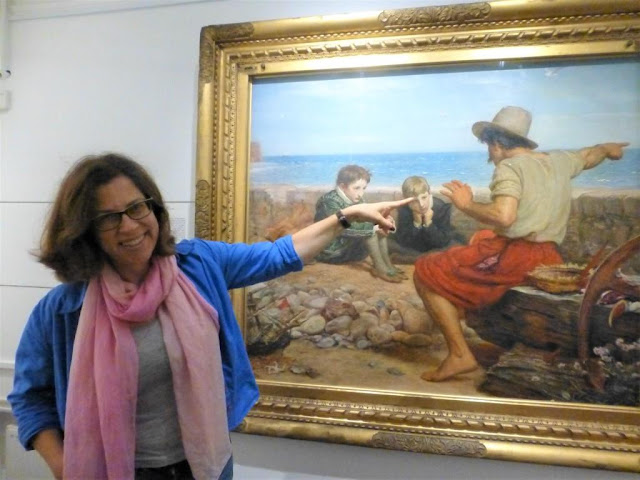
Historian Anna Beer with Sir John Millais' celebrated painting 'The Boyhood of Raleigh' as exhibited at Fairlynch Museum in 2018
Dr Beer cites John White’s illustrations and Thomas
Harriot’s study of the Algonquin language as supporting the view of those who
argue that Raleigh ‘respected the culture and people he was intruding on, and
sought to understand it and them’. However it’s fair to say that she goes on to point
out that this could be construed as a devious ‘soft imperialism’.
But it was very different from the way in which Native
Americans would later be treated by European colonists.
There is no evidence that Roger Conant ever met Morton, though
he must have heard of the goings-on at Merrymount. I wonder what he would have
thought of them. Conant had supposedly left Plymouth finding the separatist Puritans too
intolerant. But perhaps he would have felt that Morton had gone too much the
other way.
Meanwhile, Ben Crane’s book 'A Feather at the Feast' is due
for publication next year, presenting Thomas Morton as America’s first nature
writer and falconer. We know, as editor Charles Francis Adams Jr pointed out, that
Morton was ‘passionately fond of
field sports’ such as falconry. And so was Sir Walter Ralegh.
Morton’s 'New Canaan', Governor Bradford’s memoirs and Nathaniel
Hawthorne’s story ‘The May-Pole of
Merry Mount’ are all important texts telling us something of the history of
America, and I hope to study them more closely. They are all accessible online.