Showing posts with label Plymouth. Show all posts

Friday, June 5, 2020

30. Portrait of a Peacemaker


John Washington’s working drawing in preparation for his painting of a famous episode in Roger Conant’s life

I’ve always loved the idea of America as a refuge for the persecuted peoples of the Old World, a place where 18th century ideals of liberty, equality and fraternity would flourish, and where justice for all was seen as fundamental to society.

So for all admirers of America and what that great country should represent for the world the current news from across the Atlantic is understandably distressing.

I’d like to think that celebrating the life of Roger Conant - a peacemaker from America’s history – may be seen as an antidote to the bad news.

And now, thanks to Budleigh artist John Washington, our East Budleigh-based Conant 400 Group has a wonderful project.

It’s the painting of a famous episode of 1625 in the life of this Massachusetts pioneer who was celebrated for his meticulous honesty, his attitude of tolerance and conciliation, and what has been described as his character of strict integrity and devotion to principle.


This commemorative plaque recording the episode was placed at Tablet Rock in Stage Fort Park. It bears these words: ‘Here in 1625 Gov. Roger Conant by wise diplomacy averted bloodshed between contending factions one led by Myles Standish of Plymouth the other by Capt Hewes. A notable example of arbitration in the beginnings of New England. Placed by the Citizens of Gloucester 1907.’  

John has made the notes below to accompany the drawing:

1. The location is based on current photographic reference of Cape Ann - with today’s lighthouse obviously removed.

2. Conant takes centre stage with a non-aggressive stance, holding a book, not a weapon, and his whole demeanour with an open hand is that of peacemaker.

3. Myles Standish, the diminutive military representative of the Plymouth Pilgrims, known by one of his enemies as ‘Captain Shrimp’, takes an arrogant and aggressive stance against anyone who gets in his way but may be a bit confused by being addressed by an authoritative peacemaker. His soldiers are behind him ready for action if required.

4. The angry and aggressive fishermen and sailors on the left are protecting themselves behind hogshead barrels as historically recorded.

5. In front of them, involved in the negotiations is Capt Hewes representing West Country merchants who had sent the fishermen and sailors intending to take over the bankrupt Dorchester Company’s assets.   

6. The ship at anchor is similar to the Mayflower and could be the Ann although there is no imagery to record what class of ship she was (any information might be helpful).

7. In the background, away from the conflict is a native American who may have been the guide for the meeting. He is not involved and lost in his own thoughts. 

John would love to hear people’s reactions to his drawing. ‘One thing that would be helpful for me is to learn what class of ship the Ann was,’ he says. You may be a member of the Conant 400 Facebook group, a descendant of Roger Conant or just interested in New England’s history. Helpful contributions and suggestions would be most welcome. 

Continued at 
https://conant400.blogspot.com/2020/06/painting-from-history-two-artists-at.html

You can access other posts on this blog by going to the Blog Archive (under the ‘About Me’ section), and clicking on the appropriate heading.


Tuesday, February 11, 2020

23. Roger Conant on Cape Ann Part II: The Rescue Party By Mary Ellen Lepionka, January 2020


Roger Conant on Cape Ann
Part II: The Rescue Party
By Mary Ellen Lepionka, January 2020

The Dorchester Company was officially dissolved in the fall of 1625 as unprofitable and unsustainable. Two ships set sail from Weymouth with relief supplies and instructions to bring home to England any settlers who wanted out. Most of the Zouch Phoenix arrivals had stayed through the winter of 1624-1625 along with the few fishermen remaining from the first season. The Company ultimately would occupy Fishermen’s Field from the winter of 1623-1624 to the fall of 1626, when the site was abandoned. This amounted to two and a half years comprising three winters, three fishing seasons, and two growing seasons. White blamed the venture’s failure as much on poor leadership and unproductive labor as on poor fishing and planting and the vicissitudes of international markets. He also observed that fishing and planting require entirely different settings and conditions, that fishermen do not necessarily make good builders and planters and vice versa, that laying the foundation for a colony involves sunk costs that cannot be recovered, and that colonies cannot be expected to become profitable right away:

"Two things withall may be intimated by the way, the first, that the very proiect it selfe of planting by the helpe of a fishing Voyage, can never answer the successe that it seemes to promise (which experienced Fisher-men easily have foreseene before hand, and by that meanes haue preuented divers ensuing errors) whereof amongst divers other reasons these may serue for two. First that no sure fishing place in the Land is fit for planting, nor any good place for planting found fit for fishing, at least neere the Shoare. And secondly, rarely any Fisher-men will worke at Land, neither are Husband-men fit for Fisher-men but with long vse & experience. The second thing to be obserued is, that nothing new fell out in the managing of this stocke seeing experience hath taught vs that as in building houses the first stones of the foundation are buried vnder ground and are not seene, so in planting Colonies, the first stockes employed that way are consumed, although they serue for a foundation to the worke."

White nevertheless was desperate to protect the Company’s property and interests on Cape Ann and to provide leadership, religious stewardship, and provisions for the settlers who had chosen to remain. John Conant, a Dorchester Company investor and Pastor of Lymington, alerted White to the fact that his brother Roger Conant had emigrated to New Plymouth in 1623 and might make a good manager for the Company’s affairs at Cape Ann. The Company wrote to Roger Conant inviting him to come up from Plymouth to manage the property until it could be disposed of through the bankruptcy proceedings and to lead those who stayed, along with any new settlers who showed up. Conant was at Nantasket (present-day Hull, Massachusetts) at the time with some ex-Plymouth fishermen, helping to operate a satellite fishing station and trading post for the lucrative fur trade with the Wampanoag. 

Roger Conant, a London salter (saltmaker and trader in salt), and his brother Christopher, a London grocer, had settled in Plymouth with their families in 1623. They apparently disliked the religious intolerance of the Pilgrims, however, and the Separatist sentiments they found there, including the so-called Brownists, whose efforts led ultimately to the establishment of the Congregational Church in New England. Separatism vs. ecclesiastical reform—breaking away from the Church of England  versus changing the way it was conducted—and Royalists vs. Parliamentarians—having a monarchy vs. a representational democracy--were religious and political issues in the coming English Civil War of 1642-1651, which was dividing English settlers in the colonies as well. The Conant families left for Nantasket in 1624, following the anti-Separatist and Royalist Puritan preacher John Lyford and the free-thinking trader John Oldham, both of whom had made themselves unwelcome in William Bradford’s Plymouth Plantation.

Conant accepted the Dorchester Company’s offer and joined the Zouch Phoenix settlers at Fishermen’s Field in the summer of 1625. He brought his family with him (a wife and two or three children born to them by that time). He also brought Nantasket fishermen Richard Norman and his son Richard Norman Jr. (Norman’s Woe is named for a Norman family loss in a shipwreck on that rock off the Gloucester Massachusetts coast), Thomas Gray, John Gray, Walter Knight (who had likely purchased land at Hull from the Neponset sachem Chickatawbut), Knight’s wife and five children, the Rev. John Lyford, and the trader John Oldham. Oldham subsequently declined an offer of a monopoly on the Cape Ann Indian trade and did not stay with Conant’s party.


Fishermen’s Field at Stage Fort Park, Gloucester, MA

At Cape Ann, Conant found a settlement barely capable of eking its way through the winter of 1625-1626. He soon declared conditions too harsh for a plantation, the soil too poor and rocky, and the fishing grounds too inconveniently far away. He also found that though the men had built a pier and flake yard and had erected a meetinghouse, operations for receiving, salting, and barreling fish had not been developed, and the plantation was inadequate. The plantation harvest (they were trying to grow English barley from imported seed sown in glacial till) was too meagre to feed them. The people were quarrelsome, living in the Pawtuckets’ wigwams, relying on the Indians’ reserves of corn to survive, and falling ill. Conant wrote to White of his resolve to abandon the site. In the fall of 1626 he and a Pawtucket guide led the entire party overland southwest along the coast for 12 miles, driving their cattle before them, via the Squam Trail, to the Pawtucket village of Naumkeag (Nahumkeak), located on the Bass River where it drains Wenham Lake.

The new “Cape Ann Side” settlement that Conant and company founded near Naumkeag was in present-day North Beverly, Massachusetts—not Salem is commonly thought. The confusion stems from the fact that they called their settlement in Beverly “Salem Village”, which at that time also included parts of present-day Manchester-by-the Sea, Beverly, Peabody, Danvers, and Middleton. (In 1628 John Endicott, representing John White’s new New England Company, moved the colony’s seat across the river to present-day Salem.) The first fishing station was on Beverly Harbor below Fish Flake Hill, from the waterfront (Water Street) up to Stone Street and from Bartlett Street to Rantoul Street in present-day Beverly. The English survived their first winters through the hospitality of the Pawtucket people, with whom—by their own accounts—they planted, hunted, and fished side by side, peacefully, for the next 40 years.


Fish Flake Hill Today, Beverly, MA


Accounts differ as to the number of people with Conant on the Squam Trail to Naumkeag. One source cites “20 or 30 Dorchester Company people”, while another notes that only 2 or 3 Dorchester Company men remained. However, the 2 or 3 men must refer to the 2 or 3 “men of substance” (John Balch, John Woodbury, and Peter Palfrey) whom Rev. John White chose to co-govern with Conant at Naumkeag. Learning that the move was a fait accompli, White implored Conant to remain at Naumkeag to maintain the integrity of the Cape Ann effort and to induce the men of substance and any others to stay at the new settlement. According to Hubbard’s account of his interview with Roger Conant:

"…Mr. White, (under God, one of the chief founders of the Massachusetts Colony in New England,) being grieved in his spirit that so good a work should be suffered to fall to the ground by the adventurers thus abruptly breaking off, did write to Mr. Conant not so to desert his business; faithfully promising, that if himself with three others, (whom he knew to be honest and prudent men,) viz., John Woodbury, John Balch and Peter Palfreys, employed by the adventurers, would stay at Naumkeag, and give timely notice thereof, he would provide a patent for them, and likewise send them whatever they should write for, either men or provisions, or goods wherewith to trade with the Indians. Answer was returned that they would all stay on those terms, intreating that they might be encouraged accordingly."

The plaque on Conant’s famous statue in present-day Salem attests to his difficulty in persuading people to stay. The plaque quotes from the following statement in Conant’s report to the Mass. Bay Colony General Court: 

"…[When] in the infancy thereof, [the colony] was in great hassard of being deserted, I was a means through grace assisting me, to stop the flight of those few that there then were heere with me, and that by my utter deniall to goe away with them, who would have gone either for England or mostly for Virginia, but hereupon stayed to the hassard of our lives."


Roger Conant Plaque, Salem, MA


Meanwhile, Rev. John White created the New England Company out of the ashes of the Dorchester Company and sent relief supplies to Cape Ann. On March 19, 1627, he had the Dorchester Company’s property transferred to the New England Company for a Plantation on Massachusetts Bay. This was an unincorporated joint stock company with 90 West Country investors, including some of the original Dorchester Company investors, each contributing £50. Richard Saltonstall was the chief shareholder. The very next day, supplies were loaded on two ships at Weymouth under a license to Simon Whetcombe and associates of the new Company. White, himself lacking the funds to invest in the new company, nevertheless fulfilled his promise to resupply the settlers. The relief ships found no one at Cape Ann but managed to locate them at Naumkeag and delivered provisions of cattle, fodder, beef, cheese, butter, soap, oil, beer, and clothing. 

Settlers returning to England in 1625 had leaked word about the Dorchester Company bankruptcy and imminent abandonment of Cape Ann, prompting some West Country investors to attempt to claim the abandoned assets, especially the barrels of salt, as a means of recovering their money. They hired a Capt. John Hewes, a Welshman, to sail up from Plymouth on their behalf to seize whatever was there. Thus begins a famous confrontation on Fishermen’s Field in which Roger Conant is credited with averting bloodshed.

When Governor Bradford learned—from Capt. Peirce in the Anne, who was fishing in Gloucester waters at the time—that Hewes was attempting to take over Dorchester Company assets at Cape Ann, he sent Miles Standish with some marines to protect the interests of Plymouth Plantation. Plymouth had a prior claim on Cape Ann. In 1623, the same year that John White received a patent for Cape Ann, Edward Winslow and Robert Cushman of Plymouth purchased a patent for Cape Ann from Lord Sheffield:

"Wynesseth that the said Lord Sheffield…Hath Gyven…for the said Robert and Edward and their associates…a certaine Tracte of Ground in New England in a knowne place there commonly called Cape Anne…Together with the free use of the Bay of Cape Anne…and free liberty to ffish, fowle, etc. and to trade in the lands thereabout, and in all other places in New England aforesaid whereof the said Lord Sheffield is or hath byn possessed…Together also with ffive hundred Acres of free Land adioyning to the said Bay…for the building of a Towne, Scholes, Churches, Hospitals, etc. also Thirty Acres of Land and besides…to be allotted…for every particular person that shall come and dwell at the aforesaid Cape Anne within Seaven yeares next after the Date hereof." 

Unaccountably, Sheffield had promptly sold his charter to Plymouth. The sale was unauthorized and therefore unenforceable. Bradford referred to it as a “useless patent” and complained that he had been “dispossessed of Cape Ann by West Country adventurers”. In 1624 the Plymouth Company nevertheless tested the waters by sending a fishing expedition and salter to Cape Ann to set up a saltworks and erect a stage at Gloucester Harbor. They found the Dorchester Company already there with a patent of its own and the rudiments of a plantation on Fishermen’s Field. 

In its rush to get Puritan colonies going in New England, in competition with Pilgrim colonies as well as with the more prosperous Virginia Colony, the Council for New England had awarded charters for Cape Ann to both Rev. John White and Lord Sheffield, a real grounds for conflicting claims to Cape Ann. In addition, there was Ferdinando Gorges’ and John Mason’s earlier King’s Grant (from King James I), which had included all of eastern North America north of the Virginia Colony and predated even the founding of Plymouth. 


So the historical marker commemorating that confrontation is not accurate. Roger Conant’s intervention may have averted bloodshed—Miles Standish did threaten Hewes and his men—but there were really three factions, not two, and they were not contending for a fishing stage. They were contending for all the Dorchester Company’s assets there, and Plymouth in addition was attempting to enforce its claim to Cape Ann. 


"Modified wigwams with chimneys instead of smoke hole"

In any case, if the Dorchester Company was abandoning Cape Ann, Bradford wanted to claim it for Plymouth and build a permanent fishing station there. According to accounts of the 1625 confrontation, Hewes and his men barricaded themselves behind barrels of salt in the flake yard and Standish threatened to open fire on them, when Roger Conant and company “rushed from their huts” (modified wigwams with chimneys instead of smoke hole) to explain that by English law everything in Fishermen’s Field was still Dorchester Company property pending the outcome of bankruptcy proceedings. With that, all the parties dispersed. The West Country men under Capt. Hewes left for Plymouth’s trading post at Cushnoc on the Kennebec River near present-day Augusta, Maine. They had managed to steal some barrels of salt from Fishermen’s Field, which they sold en route at a trading post at Piscataqua, New Hampshire. Ten years later, John White sued the West Country merchants who had employed them to repossess that salt. Meanwhile, Bradfort recalled Capt. Peirce and Miles Standish to Plymouth, and Roger Conant and his rag tag retinue left Cape Ann for Naumkeag.    

(To be continued. Part III is on Roger Conant in Naumkeag.)


Sources:

Adams, Herbert B. The Fisher Plantation of Cape Anne, 1882. Part I of The Village Communities of Cape Ann and Salem, Historical Collections of the Essex Institute: 19. (Salem, MA).

Babson, John. 1860. History of the Town of Gloucester, pp. 16-18.

Bradford, William. Bradford’s complaint of having been dispossessed of Cape Ann by adventurers is in several letters and his commonplace book. His account of the confrontation in Fisherman’s Field is in his entries for 1626 in his History of Plimoth Plantation.  For Plymouth on Cape Ann prior to Dorchester Company arrival see Bradford, Records of the Great Council of Plymouth (February 18, 1622-1623).


Bradford, William and Edward Winslow, Mourt’s Relation, or Journal of the Plantation at Plymouth (1622).

Bremer, Francis Bremer. 1996. The Puritan Experiment: New England Society from Bradford to Edwards; also Bremer and Webster, eds. 2006. Puritans and Puritanism in Europe and America: A Comprehensive Encyclopedia.  

Conant, Frederick Conant. 1877. History and Genealogy of the Conant Family in England and America (http://www.archive.org/details/historygenealogy00cona). 

Gannon, Fred A. n. d. Roger Conant and the Fishing Station of 1626. In Some Starts of Industry and Commerce in Old Salem. Salem, MA: J. N Simard.

Gardner, Frank. 1907. Thomas Gardner, planter (Cape Ann, 1623-1626; Salem, 1626-1674).

Gorges, Ferdinando. Sir Ferdinando Gorges and His Province of Maine: A Briefe Narration... (1658); America Painted to the Life…. (1659); and Letter relating to Maine, Essex Institute Historical Collections 7: 271 (1661). 

Hubbard, William. 1815. A General history of New England: from the discovery to 1680. Volume 5 of Collections of the Massachusetts Historical Society. Boston, MA: Hilliard & Metcalf.

Knight family of Salem, Early records of. Essex Institute Historical Collections 2: 256.

Levett, Christopher. 1628. A Voyage into New England Begun in 1623 and Ended in 1624, Performed by Christopher Levett, his Majesties Woodward of Somersetshire, and one of the Councell of New-England. London: William Jones, for the Council of New England.

Maverick, Samuel. 1660 (Reprinted 1885). A Briefe Description of New England and the Severall Townes Therein, Together with the Present Government Thereof. In New England Historical and Genealogical Register 39: 33-47.

Morton, Thomas (1545-1676). 1637; 1883. Charles Francis Adams, ed. The New English Canaan. Boston: The Prince Society (John Adams Library).

Naumkeag: Good relations among Pawtucket and colonists on Cape Ann and at Naumkeag is attested by Edward Johnson in Wonder-Working Providence of Sions Saviour in New England (1654) and Good News from New England (1658) and by William Wood in New England’s Prospect: A True, Lively, and Experimental Description of That Part of America, commonly called New England (1634): http://www.comity.org/Wood_NE_Prospect.htm.

Norman family of Salem, Biographical sketch and Early records of. Essex Institute Historical Collections 1: 191, 1: 192, 2: 299, 3: 190, 9: 113, 17: 84. 

Phillips, Stephen Willard. October 1955. Evolution of Cape Ann Roads and Transportation 1623-1955. In Transportation. Salem, MA: Essex Institute Publications.

Phippen, George D. Biographical sketch of Roger Conant. Essex Institute Historical Collections: 1: 145.  

Records of the Great Council of Plymouth, February 18, 1622-1623 (Boston: Commonwealth Museum) and Records of the Colony of New Plymouth in New England, Vol. I Deeds & Etc. 1620 to 1651, in the Book of Indian Records for Their Lands (Massachusetts Historical Commission Archives, 1861). 

Russell, Michael. 2007. Members of the Dorchester Company 1624-1626. In Pilgrims of Fordington & Dorchester Dorset England: http://freepages.genealogy.rootsweb.ancestry.com/~fordingtondorset/Files/FordingtonDorchesterCo2.html; and Dorchester Company Ships: http://freepages.genealogy.rootsweb.ancestry.com/~fordingtondorset/Files/RichardBushrod1576.html. 

Thornton, John Wingate. 1854. The Landing at Cape Ann: or, The charter of the first permanent colony on the territory of the Massachusetts Company. New York: Gould and Lincoln; August 29, 1862. Colonial Schemes of Popham and Gorges. Speech given at the Fort Popham Celebration, August 29, 1862. Maine Historical Society. Boston: Edward I. Balch (1863).

Webber, Carl and Winfield S. Nevins. 1877. Old Naumkeag: An Historical Sketch of the City of Salem, and the Towns of Marblehead, Peabody, Danvers, Wenham, Manchester, Topsfield, and Middleton. Salem, MA: A. A. Smith.

White, Rev. John. October 12, 1634. The Adventure for 1623-1628 in New England. Proceedings of the Court of Requests of Charles I, London.

White, Rev. John, 1630, The Planter’s Plea (London: William Jones); John White’s Planter’s Plea, 1630, printed in facsimile with an introduction by Marshall H. Saville, The Sandy Bay Historical Society Publications Volume I (Rockport, MA, 1930), pp. 70-77; 79-84.

Wilkie, Richard W. and Jack Tager. 1991. Map of Native Settlements and Trails c. 1600-1650, p.12, Historical Atlas of Massachusetts: http://www.geo.umass.edu/faculty/wilkie/Wilkie/maps.html

Winslow, Edward. 1624. Good Newes from New England: A true relation of things very remarkable at the Plantation of Plimoth in New England (1996 reprint, Applewood Books). 

Winthrop, John. 1649 (Reprinted 1908). History of New England 1630-1649. James K. Hosmer, ed. New York: Charles Scribner’s Sons. (Also 1853, James Savage, ed., The University of Michigan).

Winthrop Society, the. The Residents of Salem, First Town of the Massachusetts Bay Commonwealth:
From Original Records up to the Year 1651: http://www.winthropsociety.com/doc_salem.php. 

Woodbury, Humphrey. Deposition on his father John Woodbury’s arrival in Salem Village in 1624:  http://dougsinclairsarchives.com/woodbury/johnwoodbury1.htm#vitals. 

Young, Alexander. 1846, Chronicles of the First Planters of the Colony of Massachusetts Bay, 1623-1636, Volumes 41 and 49 (Also Volume 1, p. 12). Boston, MA: C. C. Little and J. Brown.

© Mary Ellen Lepionka, 2020

Continued at https://conant400.blogspot.com/2020/02/roger-conant-on-cape-ann-part-iii.html


Friday, January 10, 2020

20. Mayflower 400: celebration or 'call-out'?


The banner that I designed for Henry Carter FRS

A few weeks ago I happened to mention online an exhibition that I had staged at our local museum back in 2013. It was a bicentennial tribute to East Devon’s only native-born Fellow of the Royal Society: the physician, geologist and naturalist Henry John Carter.

Carter has given his name to a species of gecko, a variety of frankincense tree, a parasitic fungus and many species of sponge. Charles Darwin, a contemporary, praised his research.


A view of Carter's home town of Budleigh Salterton from the sea, and the blue plaque on the wall of his home Umbrella Cottage, on Fore Street Hill

Born in 1813, he spent much of his working life abroad before retiring to his birthplace of Budleigh Salterton where, in 1872, he explained in a letter to one of his former teachers that he was devoting his leisure to scientific studies “in order to follow your precept of making fellow-creatures better and happy.” 

A good and gifted man, therefore. A humanist, as is clear from the anger that he expressed in a diary entry at the inhumanity of the caste system in India. But a Victorian.


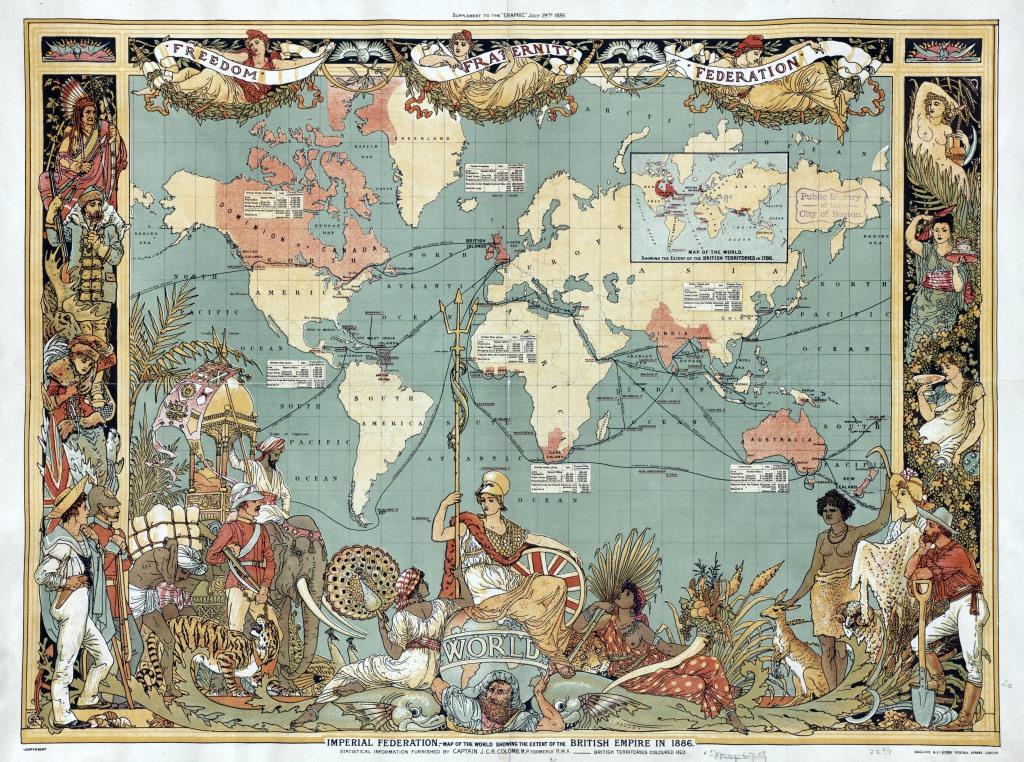
The Extent of the British Empire in 1886
Published as a supplement to the 'Graphic' magazine 24 July 1886 with statistical information furnished by Captain J.C.R. Colomb MP, with British territories coloured red 
Artist: Walter Crane (1845-1915)

And that mention of India disturbed one of my readers.  “Not sure I would describe anyone associated with the East India Company in any positive way. A bit baffled as to why that appears on here as if to be celebrated!?” she wrote in a comment on social media. “Colonialist horrors exist in all kinds of places. It is important to call them out for what they are though.”


Left: This painting in All Saints' church, East Budleigh, is a copy of one of the best known portraits of Sir Walter formerly attributed to Zuccaro but now to the monogrammist 'H' (? Hubbard) and dated 1588. It shows Raleigh in court dress at the height of his favour with Queen Elizabeth I. The illustration by an uncredited artist, right, circa 1860, is an impression of the execution of Sir Walter Raleigh (who refused a blindfold).  Included in 'The Popular History of England: An Illustrated History of Society and Government from the Earliest Period to Our Own Times,' by Charles Knight.  

What she had written reminded me of a similarly outraged response – though a bit garbled - by an Exmouth resident when I suggested that our museum should honour local hero Sir Walter Raleigh in 2018 by marking the 400th anniversary of his death. 

“Celebrate Walter Raleigh no chance he made his money from the slave trade along with Elizabeth a disgrace nothing to celebrate there along with the mayflower ship leaving from Plymouth a boat load of poor innocent men, woman and children set voyage for a disgusting life chained up whipped and beaten and rape defo no and to work day and night poor slaves. America made great through the slaves along with Britain.”


I got the sense of what she was saying of course. I didn't tell her that Raleigh had been dead for two years when the 'Mayflower' sailed from Plymouth in 1620.  


Frontispiece illustration from 'Upper Canada Sketches'  by Thomas Conant  Toronto: William Briggs 1898. It shows the former mill house in East Budleigh, demolished in the early 20th century

I’m wondering now what kind of response there will be to the suggestion that East Budleigh honours its other hero: Roger Conant, born in 1592 at the village’s mill house, who went on become a member of the Salters’ Company in London, took ship for America three years after the Plymouth Pilgrims and in 1626 founded the coastal city of Salem in the state of Massachusetts.

One local resident whom I invited to take part in a commemorative project to honour Conant responded:  “Whilst the historic connection between East Budleigh and Salem, and the importance of the salting industry is a vital part of our heritage, the colonial nature of the subject sits uncomfortably with me howsoever significant. The cost of colonialism to indigenous communities has been so great.”

2020 has a problem which was not there a century ago when the 300th anniversaries of Raleigh’s death and the sailing of the Mayflower were remembered.

In October 1918, in the midst of the bombardments and the slaughter of the Great War, Britain took time off to celebrate the life of Sir Walter for his tercentenary. Its politicians clearly wanted to show their gratitude to America for its support of the Allies, even if it had come in at a late stage. Germany of course had been desperately hoping to keep the US out of the conflict. 

Celebrating Mayflower 300 would have been an extension of that celebration to stress the UK-US ‘special relationship’.  You can read more about the Raleigh tercentenary at http://raleigh400.blogspot.com/2018/01/raleigh-300-how-did-they-mark.html


Sir Francis Drake whilst playing bowls on Plymouth Hoe is informed of the approaching Spanish Armada. One of four bronze relief plaques on the base of the Drake statue in Tavistock, Devon. By Joseph Boehm (d.1890), donated by Hastings Russell, 9th Duke of Bedford   Image credit: Lobsterthermidor 

And in 2020 the city made famous by the departure of the 'Mayflower' – even though none of the Plymouth Pilgrims came from Devon – has a difficulty.  The glorious reputation that it enjoyed a century ago – where heroic Sir Francis Drake played bowls on Plymouth Hoe before sailing out to defeat the Spanish Armada and keep England free from the tyranny of the Inquisition – is under attack. Today, Drake is commonly known not just as an English sea captain and explorer but as a slave trader.


Portrait of Admiral Sir John Hawkins, National Maritime Museum, London. Artist unknown.  Right are the arms granted to John Hawkins in 1565, for the massive profits he made in the slave trade. Included is a "demi Moor in his proper colour, bound and captive, with annulets in his arms and ears". Image credit: William Harvey - College of Arms, United Kingdom


Thanks to Drake’s cousin Sir John Hawkins, the city is even more tainted. “Interestingly the English chapter in the history of slavery begins in Plymouth,” reads a BBC report of 2014. “John Hawkins was England’s first slave trader. In 1562 he sailed from the Barbican in Plymouth with three ships and violently kidnapped about 400 Africans in Guinea, later trading them in the West Indies.”

Back in 1994, Plymouth City Council called off plans to celebrate the 400th anniversary of Hawkins’ death because of his links with the African slave trade.  But the organisers of Plymouth’s Mayflower 400 are well aware that the stain of the supposed Elizabethan origins of slavery has spread wider. To that crime has been added what the website calls the ‘horrific genocide’ of America’s  indigenous peoples, committed over the centuries by those who followed the 1620 Pilgrims.  

For that reason, for four weeks in July and August  2020 in Plymouth’s Central Park,  a group of 20 Native American indigenous and mixed heritage artists will “both present and live in a radical large-scale installation of public art”  in what is described as “a groundbreaking project linking communities across the globe”.  The event, entitled ‘Settlement’ will  “investigate and interpret their lives as the survivors of settler colonialism".


Village of the Secotan Indians in North Carolina, by John White in 1585. British Museum, London. 

It is indeed shocking to learn, from the Mayflower 400 website that the population of Native Americans before contact with Europeans was between 9 and 18 million and that by the latter part of the 19th century it had been reduced to approximately 250,000. “Boarding schools, involuntary sterilisation and mass murder” were among the methods used in what has been called – incidentally by a Conant descendant  elsewhere on this blog – “a holocaust”. 


Adolf Hitler poses for the camera in 1930
Image credit: Bundesarchiv Bild and Wikimedia

The terminology matches all too well what we know of genocide in Europe. An article in 'The New Yorker' magazine of 30 April 2018 noted how Hitler, in his book 'Mein Kampf' had praised America as the one state that has made progress toward a primarily racial conception of citizenship, by “excluding certain races from naturalization.” Three years later, in 1928, he remarked, approvingly, that white settlers in America had “gunned down the millions of redskins to a few hundred thousand.”

Comparing the official American and British Mayflower 400 websites, Prof Donna Seger, Head of History at State Salem University, commented in a post for 1 January 2020 in her ‘Streets of Salem’ blog on the "sophistication, earnestness, and creativity of the British commemoration of the Mayflower voyage"; the American version in her view was no more than a Chamber of Commerce production.


The Mayflower 400 logo

And yet, for critics, there is no end to the ‘call-out’ for colonialism. With Plymouth’s programme of events well under way in November 2019, writer and local resident Angela Sherlock, in a letter to the 'Guardian' newspaper, was complaining that “Mayflower 400 is commemorating the Mayflower voyage of 1620 without reference to the context and aftermath of that colonising venture”.  The voyage, she wrote, “was an invasion, seeking profit, and part of that process was the construction of a racial categorization”.

I suspect that so far the attention of the British public has been focused on Brexit rather than on Mayflower 400, but surely in the coming year that will change. I am looking forward to experiencing and learning from some of the events in Plymouth that should make us both share in the American dream and reflect on the nightmare.

Some useful links:
https://www.mayflower400uk.org/
https://www.plymouth400inc.org/   
https://streetsofsalem.com/2020/01/01/2020-the-commemorative-year/

You can access other posts on this blog by going to the Blog Archive (under the ‘About Me’ section), and clicking on the appropriate heading.