Showing posts with label Fairlynch. Show all posts

Saturday, August 27, 2022

60. Of Flour and Salt: Roger Conant the Salter


The Salters' Company arms. The Latin motto means 'Salt Savours All'

Roger Conant's father Richard has been described as East Budleigh's miller, and the village mill house has traditionally been viewed as the family home. Recent research has shown that such stories need to be taken with a pinch of salt. (Sorry!)

 It is known that by 1620, when he was living in London, Roger Conant described himself as a salter. He may well have gained experience of the salter’s trade in his native Devon.


‘The horrid history of Hugo the salter’, sculpture by Angie Harlock in Budleigh Salterton's Fairlynch Museum. The display tells how the Prior of Otterton supposedly discovered the body of one of his salt workers who sadly drowned in a barrel of salted herring 


Salt had been harvested on the coast since Roman times, contributing to the prosperity of Otterton Priory. But by the 17th century it was being imported rather than harvested locally on Budleigh’s salt marshes.

And in any case the trade of a salter had evolved from merely gathering salt from brine in salt-pans. The term was used to refer to both employees of a salt works and to specialists in salting fish or meat. By 1726 Daniel Defoe was using it to describe traders involved in the ‘buying of cochineal, indigo, galls, shumach, logwood, fustick, madder, and the like’.

The modern day association of the London-based Salters’ Company with chemistry and science can be traced right back to salters’ use of chemical preparations involving such ingredients in a variety of industries.


Left:  Interior of a bag, purse and glove maker's workshop (woodcut by Jost Amman, 1568); 16th century kid gloves, on loan from Dents Museum, displayed in 2018 at Fairlynch Museum’s Raleigh 400 exhibition 

Leather workers were especially skilled in the art of transforming raw hides into the delicate material used to make these gloves, exhibited as part of Fairlynch Museum’s Raleigh 400 display in 2018.


Hides being processed at J. & F.J. Baker’s tannery 

Salt was traditionally used in the leather industry to prevent hides from rotting before they are tanned. It is still part of the process used at the centuries-old tannery of J. & F.J. Baker, in Colyton, home to the family of Roger Conant’s mother.  


Christopher's, the former tannery in East Budleigh
Image credit: Otter Valley Association

Could Roger Conant have learnt some of the salter’s skills nearer home? Until the 1830s East Budleigh had its own tannery at the house known today as Christopher's, a Grade II listed cob, stone and thatch cottage.  For 300 years it flourished as a tannery, supplying tanned hides for boots, shoes, and saddlery, including, it is said, buckets produced for the Tudor navies.

In 1609, aged 21, Roger’s brother Christopher Conant was sent to London, where he was apprenticed to Thomas Allen, a grocer, and was admitted to the freedom of the Grocers' Company on 14 March 1616.

Like the Salters, many members of the Grocers’ Company were associated with food preservation, important at a time when meat was often so ‘off’ that it needed spices to make it palatable!  


The Pepperers’ Guild, first mentioned in 1180 AD, was a forerunner of the Grocers’ Company, and was concerned with the import and storage of pepper and other spices: cloves feature on the Company’s coat of arms, above. Some Grocers were also apothecaries; indeed in the late 16th and early 17th centuries, some were prosecuted by the College of Physicians for practising medicine. 

Roger also left Devon for the capital to learn a trade, but no similar documentation exists for him: the records of The Salters’ Company were destroyed in the Great Fire of London in 1666.


Top: ‘Men carry meat and other wares through the streets of London’ - c. 1615–16 Michael van Meer    © The University of Edinburgh; The Fish Market,1568, by Joachim Beuckelaer 
The Metropolitan Museum of Art of New York City


During his time as an apprentice salter, Roger Conant would have learnt further about how salt was used.  Before the advent of refrigeration, along with drying, pickling and smoking, heavy salting was one of the main means of preserving food. Hard cured fish could be stored for months and sometimes years. 

Apart from the tanning and leather industries, salt was also used in dyeing fabrics and in the formulation of medicines and ointments. 


Winchcombe, Gloucestershire. One of the roads in the town is named Tobacco Close  

The diversity of salters' interests can be seen in the case of the London merchant John Stratford, a member of the Salters' Company. In 1619, he purchased spare land in and around Winchcombe in Gloucestershire and planted tobacco, seen at this time as having medicinal qualities.  Unfortunately for him, the Act of Parliament banning tobacco growing in England was passed in that year, just as the first crop in Winchcombe was ready to harvest.


The Great Fire of London, depicted by an unknown painter (1675), as it would have appeared from a boat in the vicinity of Tower Wharf on the evening of Tuesday, 4 September 1666. To the left is London Bridge; to the right, the Tower of London. St. Paul's Cathedral is in the distance, surrounded by the tallest flames.  


Both St Ann’s and All Hallows Church were destroyed in the Great Fire of London, along with records of the Salters’ Company

It was in London, on 11 November 1618, at St Ann’s Church, Blackfriars, that Roger Conant married Sarah Horton. One might have expected the marriage to take place at  All Hallows’ Church, next to Salters’ Hall in Bread Street, where most salters attended.


Portrait of William Gouge by Gustavus Ellinthorpe Sintzenich (1821-1892) Collection of Mansfield College, Oxford 

But St Ann’s was known as a Puritans’ church; William Gouge (1575–1653), was the minister and preacher for 45 years, from 1608.

He was also a member of the 1643 Westminster Assembly of Divines, as was Roger’s elder brother John Conant. 

The Puritan tradition remained strong in the Conant family of East Devon.


You can access other posts on this blog by going to the Blog Archive (under the ‘About Me’ section), and clicking on the appropriate heading.


Tuesday, June 16, 2020

32. History in art: Arms and the Men

Continued from   https://conant400.blogspot.com/2020/06/painting-from-history-two-artists-at.html


Budleigh resident Nick Speare as The Sailor in the 2018 ‘The Boyhood of Raleigh’ re-enactment by Fairlynch Museum volunteers. Photo credit: Rob Coombe   

Still remembering that swelteringly hot day in May 2018 when we re-enacted ‘The Boyhood of Raleigh’ on Budleigh beach, I’m continuing to relate John Washington’s sketch to Millais’ masterpiece.


Young Walter as portrayed in Millais’ The Boyhood of Raleigh

As Millais and every artist knows, hand and arm gestures play a key role in their work, guiding the viewer to a certain conclusion. Young Walter’s gaze is internalised, fixed on the world of his imagination, thousands of miles distant from what we actually see in the painting. He seems to be looking through the sailor rather than at him.


The Boyhood of Raleigh, on show for the third time at Budleigh Salterton’s Fairlynch Museum, on loan from Tate Britain

The sailor’s words and above all that outstretched arm were the stimulus for that imagination. Now, in turn, it takes ‘The Boyhood’s’ Victorian audience beyond the horizon to inspire them – and particularly young boys – with thoughts of creating an even greater British Empire. 

‘The sailor’s arm points into the distance, taking the eye out of the main frame and implying a world of romantic adventure beyond its confines,’ comments Professor Linda Dryden in her book about the novelist Joseph Conrad.


In John Washington’s sketch, above, depicting a celebrated incident on Fishermen’s Field at Cape Ann, near Gloucester MA, Roger Conant is the central figure. 

To his right is Captain John Hewes, who had been sent with sailors and fishermen by West Country investors in an attempt to claim abandoned assets of the bankrupt Dorchester Company, especially the barrels of salt, an expensive commodity. 

To Conant’s left is the diminutive Captain Miles Standish - rudely named 'Captain Shrimp' by his enemies - and a troop of armed marines who had been sent by Governor Bradford from the Plymouth Colony to protect what it saw as its assets. 


Conant’s arm, the palm of his hand open in sign of friendship, keeps the viewer firmly within the frame and focused on the smiling central figure. I notice that it’s his left hand that he extends to Standish. Was he left-handed? Who knows. 

His right hand firmly clasps a book. Perhaps it’s a folder of legal documents which he has consulted. As Gloucester historian Mary Ellen Lepionka explains, ‘According to accounts of the 1625 confrontation, Hewes and his men barricaded themselves behind barrels of salt in the flake yard and Standish threatened to open fire on them, when Roger Conant and company “rushed from their huts” (modified wigwams with chimneys instead of smoke hole) to explain that by English law everything in Fishermen’s Field was still Dorchester Company property pending the outcome of bankruptcy proceedings’.


The statue of Roger Conant outside the Witch Museum, Salem, Massachusetts
Photo credit: Kate Fox

Smiling in contrast with the rather grim-faced statue of Roger Conant that is one of Salem’s landmarks.

The sketch marks a crucial point in time and hints at a few seconds of suspense. Conant’s gesture is open and friendly, but Standish has not responded. He looks nonplussed. His background is military and he is a man of action. Will he give the order to the heavily armed soldiers behind him to open fire on the fishermen and sailors? The latter’s gestures – clenched fists and pointing fingers – are openly defiant and hostile.


An artist’s image of Captain Miles Standish from The Courtship of Miles Standish, an 1858 narrative poem by American poet Henry Wadsworth Longfellow.  The American artist N.C. Wyeth was known for his illustrations of The Last of the Mohicans (1826) and Treasure Island (1883).

How will the situation be resolved? This moment could easily have been the start of an early civil war between white settlers in America? By 1625, when the incident took place, Captain Miles Standish, one of the most prominent in the group of Plymouth Puritan separatists who had sailed on the Mayflower, had proved that he was capable of extreme violence.

Continued at https://conant400.blogspot.com/2020/06/33-kind-of-ruffling-course-in-world.html


You can access other posts on this blog by going to the Blog Archive (under the ‘About Me’ section), and clicking on the appropriate heading.


Friday, December 20, 2019

16. Of cups and plate


“You have chosen wisely,” the Grail knight tells the hero in the film 'Indiana Jones and the Last Crusade.'  Terrible things befall those who choose poorly and drink from the wrong communion cup.

And so it was during the turbulent years of religious wars brought about by the Reformation in Europe during the 16th and 17th centuries, when Protestant ‘Leavers’ struggled to break from what they saw as the tyranny of Rome. ‘Remainers’ fought equally hard to keep the Catholic traditions to which they were so accustomed.


The replica communion cup in display in Budleigh Salterton's Fairlynch Museum is an exact copy of the 16th century silver vessel from which both Sir Walter Ralegh and Roger Conant may have drunk during services at East Budleigh’s All Saints Church.

The cup tells the story of how a clever Queen of England steered a path between the two groups of extremists to ensure that her kingdom would not follow France’s example with its tragic Wars of Religion. 


‘The greatest and most grievous calamity that can come to any state is civil war,’ wrote Ralegh in his ‘History of the World’, published in 1614. He had had direct experience of such a calamity, having fought as a teenager on the Huguenot side in France.  


Left: A chalice with the inscription: 'My blood truly is a libation', made in 1549 for the church of St John the Baptist in Salinas, Spain.  © Victoria and Albert Museum, London; 
right: wooden communion cups, Bernisches Historisches Museum, Bern, Switzerland dated 1718  
https://www.reforc.com

Countries which broke from Rome and embraced Protestantism rejected the decorative, sometimes bejewelled chalices which were characteristic of the Catholic tradition.


In Europe, the most extreme example of the tendency to reject such Catholic practices was seen as early as April 1525 when the reformer Ulrich Zwingli celebrated Maundy Thursday with wooden rather than silver cups. 

Was such Protestant extremism seen in English parishes? 'It is hard to be sure what was happening, especially since there was such variation on the ground,' says Dr Laura Sangha, of the University of Exeter’s Department of History.

'We do know from churchwarden accounts that many parishes either sold their communion chalices during Edward VI's reign, or they had them confiscated by the authorities. There is also evidence that some parishes bought wooden cups at around the same time, so certainly they were in use in some places.'

Goldsmiths and silversmiths benefited enormously  from changes brought about by English Reformation.  Much church treasure was confiscated by Henry VIII, with plate being melted down and reworked to conform to the new Protestant liturgy.  The process was even more marked in the 1550s, which saw the seizure of most church gold and silver ornaments by officials of Edward VI’s government.  

In the West Country, up to and including the 16th century, silversmiths relied heavily upon the Church for business. Two notable Exeter craftsmen of the 16th century were John Jones and Richard Hilliard, father of Nicholas the famous miniaturist. 

One of the most productive silversmiths of his age, John Jones (d.1583-84) was a Bailiff of the city in 1567 and Churchwarden at St. Petrock's in 1570. 


A silver gilt communion cup and cover from St Petrock’s church, Exeter, made by John Jones in about 1572. The churchwarden’s account records that in 1571 Jones was paid one pound, 15 shillings and five pence for converting this piece from a Roman Catholic chalice into a Protestant communion cup. From the RAMM collection

You can see examples of communion cups made by both Jones and Hilliard on display at the Royal Albert Memorial Museum (RAMM) in Exeter.  More than a hundred of Jones's communion cups have survived. They made his fortune.


Queen Mary I, Portrait by Antonis Mor, 1554 Museo del Prado

The brief period of Mary Tudor’s reign saw a return to Catholic practices, welcomed by those who wanted to remain with Rome.  But by 1559 when her half-sister Elizabeth ascended the throne England was ready to ready to accept compromises in matters of religion.

The new Queen evidently shared his view. “Away with those torches, for we see very well,” she is supposed to have exclaimed at her coronation, when greeted by the Abbot of Westminster and his monks.


Queen Elizabeth I. The 'Darnley' portrait 
National Portrait Gallery

Elizabeth’s apparent rejection of the Catholic practice of lighted candles, a relic from the previous reign, would have been interpreted by Protestants as a sign of her Reformist tendencies.

Equally, the queen wanted to reassure Catholics that she respected elements of the old tradition. “The coronation was a typical Elizabethan compromise with something to confuse and offend everyone,” concludes Professor Richard McCoy in an article about the ceremony, which was keenly watched by contemporaries for hints of the government’s religious policy in the new reign.


The Elizabethan Settlement deliberately encompassed a range of preferences when it came to religious worship, and this included more decoration and ceremonial that would have been tolerated during the Edwardian regime, writes Laura Sangha.  

Fairlynch Museum’s copy of the 1570s chalice made by John Jones, moderately decorated, but not too decorated,  reflects perfectly the spirit of compromise which characterized the Virgin Queen’s reign. 


Photo of the 16th century original artefact

And that Tudor rose on the paten – the lid of the chalice - told English people that London, not Rome, was in control.  

Beautifully crafted by Birmingham pewterers A.E. Williams – probably the oldest firm of its kind in the world – Fairlynch Museum's replica of one of East Budleigh’s treasures tells a fascinating story from a crucial period in British history. 

It may give a clue as to Roger Conant's East Devon background, which would form his moderate views in matters of religion. 


You can access other posts on this blog by going to the Blog Archive (under the ‘About Me’ section), and clicking on the appropriate heading.    


Friday, November 22, 2019

11. Coming Home to Budleigh: Jeff Conant's 2016 visit to his old village home (2) - some photos


During his visit to East Budleigh in 2016 Jeff saw the millstone from the village mill which his ancestors owned five centuries ago.  The Conant stone is outside the Church Hall, overlooking the village car park on Hayes Lane. . 


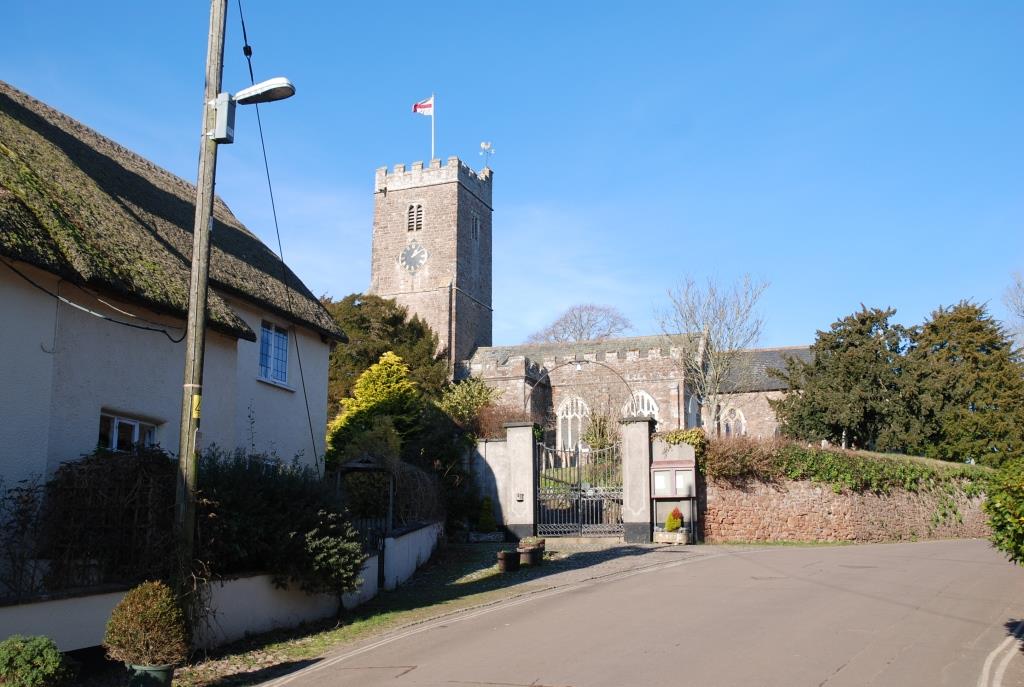
A must-see in East Budleigh is All Saints Church, where the families of Sir Walter Raleigh and Roger Conant worshipped. Both Sir Walter's and Roger's fathers were churchwardens. The church's 16th century carved oak bench ends are famous. 


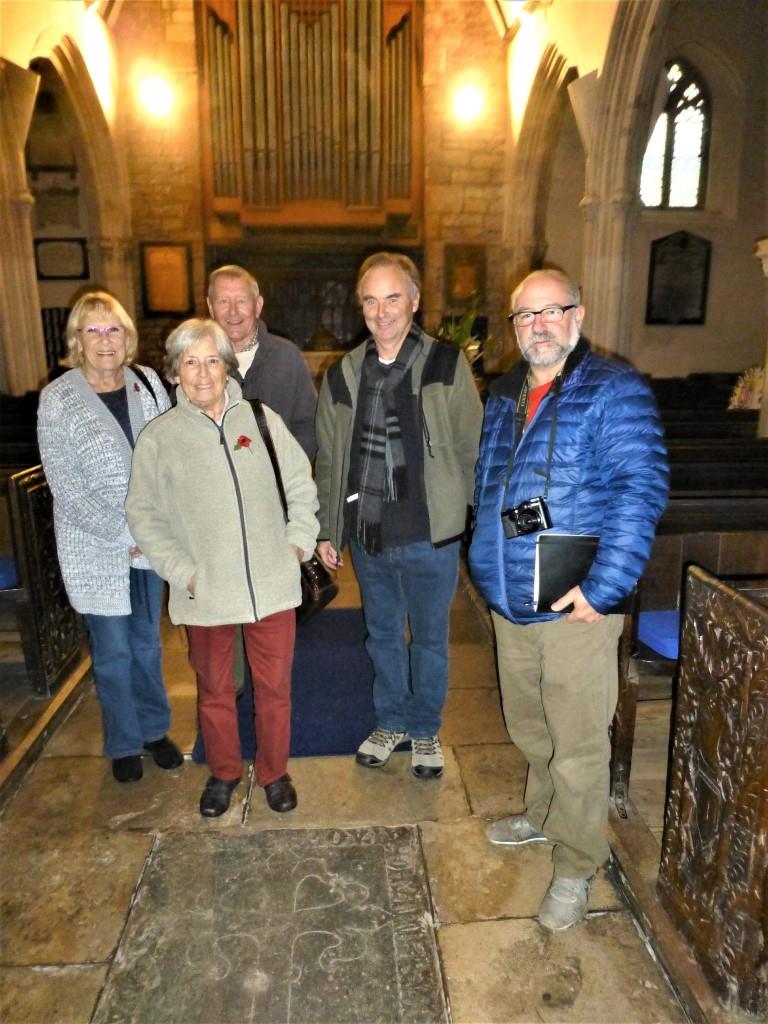
Jeff's guides during his tour of the village were l-r: Trevor Waddington (Chairman of Fairlynch Museum), local resident and All Saints Church expert Hanneke Coates, Roz Hickman (Head of Local History at Fairlynch Museum) and Anthea Downes (museum volunteer)


The Conant family pew at All Saints Church. 


In All Saints Church, looking at the nave where Sir Walter Raleigh's stepmother Joan Drake is buried.


Jeff enjoyed meeting Hanneke Coates and hearing her stories of All Saints Church and the village where she has lived for many years. 

There are many more photos - much finer than mine -  taken by Jeff during his few days in the Budleigh area. You can see them at https://qq0u.app.link/e/DIObyp1GNR

Continued at https://conant400.blogspot.com/2019/11/coming-home-to-budleigh-jeff-conants_24.html

You can access other posts on this blog by going to the Blog Archive (under the ‘About Me’ section), and clicking on the appropriate heading.

Tuesday, November 12, 2019

9. Why did Jeff Conant fly 5,286 miles from Berkeley, CA. to visit us last month?


Hands across the Pond: Jeff Conant, a descendant of Roger Conant, founder of the American city of Salem MA, contemplates his family's ancient millstone during his 2016 visit to the UK. It's all that remains of the Mill House, East Budleigh 

This article by David Daniel, History Coordinator for the Otter Valley Association, was published in the OVA Newsletter, January 2017.   

Sir Walter Raleigh is well known but few outside East Budleigh may know of his contemporary, Roger Conant. Roger was born in the Mill House, East Budleigh, on 9th April 1592 (since demolished but just above Hill Farm). He was the youngest son of Richard Conant, miller, who had married into one of the leading merchant families of Colyton. Bother Roger’s and Walter’s fathers were Church Wardens and both families have their crests carved on bench ends in All Saints’ Church.

As the youngest son of a family of eight, Roger couldn’t expect a share of his father’s estate. In 1610, or soon after, Richard followed his brother Christopher to London. Christopher became a member of the Grocers’ Guild and merchant. Roger became a salter, a trade concerned with preserving meat and fish, not to be confused with salt production. By 1618, the year Sir Walter was beheaded, Roger was well enough established to marry Sarah Horton in Blackfriars. Having lost their first child in 1619, their second child, Caleb, was born in May 1622.

So why did Roger, with his wife and baby son, set sail for New England in 1623 and eventually become the founder of Salem, Massachusetts?

Religious, political and trading conditions were changing adversely under James I. Roger was a puritan by inclination, as were some of his ordained brothers, though not a separatist (or dissenter). In 1622 three influential sermons on the subject of colonization were published. The plantation colonies of: Jamestown, Virginia (1607); and Plymouth, New England (1620) were beginning to succeed. The Plymouth Colony was well placed to supplement the century old cod fishing industry that Merchant Venturers were keen on extending throughout the year, providing opportunities for a salter. Forty vessels sailed to New England in 1623, the Conant family in one of them.

They spent their first year in the Plymouth Colony founded by pilgrim separatists who originated from Nottinghamshire but became disillusioned by the factions within the community. After a year in more congenial company in Boston Bay they moved northward to Cape Anne where Roger became the manager of the “fishing plantation” set up on speculation by “The Dorchester Company”. This Company failed and when the next boat arrived from England, Roger learned that a new Company had taken over. He was offered free passage home but instead led a small group of seasoned settlers to an abandoned Native American settlement, Naumkeag. Further funds and provisions were raised in England and in a 1626 Thanksgiving Ceremony it was renamed Salem. Roger's leadership provided the stability to survive the first two years, but he was replaced as Governor in 1628 by John Endecott, one of the new arrivals at the start of the mass migration, by order of the Massachusetts Bay Company.

From time to time descendants of Roger and Sarah Conant visit East Budleigh. Jeff (pictured) is the latest. He stayed at the King’s Arms, Otterton; took part in a quiz night; was shown around East Budleigh by members of the OVA and Fairlynch Museum; and enjoyed some hospitality in the Sir Walter Raleigh. Jeff is the Forestry Programme manager for Friends of the Earth and already knew all about our Beavers!

(Main history source: Roger Conant, A Founder of Massachusetts, by Clifford K. Shipton, © 1944, Harvard College, USA)
Article reproduced courtesy of the Otter Valley Association www.ova.org.uk 

You can access other posts on this blog by going to the Blog Archive (under the ‘About Me’ section), and clicking on the appropriate heading.