Showing posts with label Roger Conant. Show all posts

Thursday, August 4, 2022

59. Roger Conant – Further Reading!


Just one of the many books which mention Roger Conant

Our Roger Conant Club in East Budleigh, Devon, UK, is planning to launch a website devoted to the founder of Salem. I suggested that a section should include books, articles and website material devoted to Roger Conant, so I was invited to make a list. Well, I started, and this is what I have so far. There may be the odd mistake, and I’m sure that there could be many more items to be added. Please let me know if you think I’ve missed something.

I wonder whether the character of Roger Conant appears in a film.

Anyway, here’s my list:

Manuscripts and other documents:

The Conant Family papers are archived at the Peabody Essex Museum near Salem

https://www.pem.org/

Books

Bailyn, Bernard – The Barbarous Years, The Peopling of British North America: The Conflict of Civilizations, 1600-1675, New York: Alfred A. Knopf  2012

Bartlett, Sarah S. Roger Conant in America: Governor and Citizen, An Historical Address Delivered at the Conant Family Reunion, Hotel Vendome, Boston, June 13, 1901. See Roger Conant in America as Governor and citizen by Sarah Bartlett  

https://ia800200.us.archive.org/14/items/rogerconantiname00bart/rogerconantiname00bart.pdf

Bradford, William – History of Plymouth Plantation. Edited, with notes, by Charles Deane, Boston: Little, Brown, and Company, 1856

[Does Bradford refer to Roger Conant, Book II, p.170?]

https://babel.hathitrust.org/cgi/pt?id=mdp.39015014559044&view=1up&seq=198

Conant, Frederick Odell – A history and genealogy of the Conant family in England and America, thirteen generations, 1520-1887, Portland 1887.

https://archive.org/details/historygenealogy00cona/page/n4

Conant, Thomas – Upper Canada Sketches, Toronto: William Briggs, 1898 [pages 9-20]

https://www.gutenberg.org/files/64749/64749-h/64749-h.htm

Endicott, Charles M. (1847) Memoir of John Endicott, first governor of the colony of Massachusetts Bay  (John Endicott and Roger Conant co-led Salem Village after John Winthrop moved the capital of the Massachusetts Bay Colony to Dorchester.)

https://tile.loc.gov/storage-services/public/gdcmassbookdig/memoirofjohnende00endi/memoirofjohnende00endi.pdf

Felt, Joseph B. – Annals of Salem, Salem: W. & S.B. Ives; Boston: James Munrow & Co., 1845

https://www.noblenet.org/salem/reference/wp-content/uploads/2016/01/Annals-of-Salem-Felt-v.1.pdf

Gardner, Frank A. – Roger Conant: Salem, 1626. The Leader of the Old Planters, Salem, Mass: Roger Conant Co-operative Bank, 1926

Gardner, Frank A. – Roger Conant, Family Edition Supplement. Contents: A Visit to East Budleigh, by Wallace B. Conant; The Old Planters’ Grant of 1635: Notes communicated by Grace Patten Conant; collaboration in research by Alice G. Lapham; The Old Planters’ Path and the First Landing Place on Bass River, Salem, Mass [?], n.d.   

Hubbard, William – A General History of New England, Boston, 1848

https://archive.org/details/generalhistoryof00hubb

Lapham, Alice Gertrude – The Old Planters of Beverly Massachusetts and the Thousand Acre Grant of 1635, 1930, Carlisle, Massachusetts: Applewood Books

Leavitt, E.W. (1890) A Genealogy of One Branch of the Conant Family, 1581-1890 (printed privately)

https://archive.org/details/genealogyofonebr00leav_0)  

Little, George Thomas – Genealogical and Family History of the State of Maine, New York: Lewis Historical Publishing Company, 1909

http://dunhamwilcox.net/me/me_bio_conant.htm

Rose-Troup, Frances –  John White, The Patriarch of Dorchester, Dorset and The Founder of Massachusetts, 1575-1648, With An Account Of The Early Settlements In Massachusetts, 1620-1630, New York & London: G.P. Putnam’s Sons, 1930

Shallop, Benjamin - The Founding of Salem: City of Peace. Paperback, 144 pages. The History Press, 2022

Sheppard, Lilian – Raleigh’s Birthplace: The Story of East Budleigh, Budleigh Salterton: The Granary Press, 1983 [pages 45-46]

Shipton, Clifford K. –  Roger Conant: A Founder of Massachusetts, Cambridge: Harvard University Press, 1944.

https://www.seekingmyroots.com/members/files/G001153.pdf  

Stone, Edwin Martin – History of Beverly, Civil and Ecclesiastical: From Its Settlement in 1630 to 1842, Boston: J. Munroe, 1843

https://archive.org/details/historyofbeverly00ston

Thornton, John Wingate – The Landing at Cape Anne or The Charter of the first permanent colony on the territory of the Massachusetts Company, Boston; Gould and Lincoln; New York: Sheldon, Lamport and Blakeman, 1854  

https://archive.org/details/landingatcapean00thor

Webber, Charles H. & Nevins, Winfield S. – Old Naumkeag: an historical sketch of the city of Salem, and the towns of Marblehead, Peabody, Beverly, Danvers, Wenham, Manchester, Topsfield, and Middleton, Salem: A. A. Smith & company; Boston, Lee & Shepard, 1877

https://archive.org/details/oldnaumkeaghisto00webb/page/n8


Roger Conant as depicted in fiction:

Olson, Charles – The Maximus Poems, New York: Jargon/Corinth, 1960

Hawthorne, Nathaniel – Main Street in The Snow-Image and other Twice-Told Tales, 1852

https://www.gutenberg.org/files/513/513-h/513-h.htm


Articles

Daniel, David – Why did Jeff Conant fly 5,286 miles from Berkley, CA. to visit us last month? in Otter Valley Association Newsletter, vol.38.1 (January 2017), pages 7-8.

https://www.ova.org.uk/sites/default/files/common/Newsletter%202017-01.pdf

Downes, Michael – A tribute to East Budleigh's other hero in Otter Valley Association Newsletter, Summer 2022, pages 13-15.

Sabine, Lorenzo - Report on the Principal Fisheries of the American Seas, in Cod and Whale Fisheries: Report of Hon. Thomas Jefferson, Secretary of State, United States. Department of the Treasury pages 108-113, 293-298. Originally published in 1853.

https://shareok.org/handle/11244/35684  (House-32-2-Executive-23.2-Serial-676.pdf)


Websites

https://augustinesalley.wordpress.com/ [Joseph Bolton]

https://www.ova.org.uk/article/east-budleigh-%E2%80%93-historical-sketch  [Vivien Brenan – East Budleigh – Historical Sketch]

 http://www.lyndon-estate.co.uk/history/index.html

[Lyndon Conants, UK]

https://conant400.blogspot.com/2022/07/conant-connections-past-and-present-at.html  [Michael Downes]

https://climbingthemooneytree.wordpress.com/2018/02/05/roger-conant   [Kelcey Mooney]


Gloucester historian Mary Ellen Lepionka kindly contributed the following three essays to my blog site, as follows: 

Roger Conant on Cape Ann Part I: The Dorchester Company [12 March 2019]

https://conant400.blogspot.com/2020/01/roger-conant-on-cape-ann-part-i.html 

Roger Conant on Cape Ann Part II: The Rescue Party [January 2020]

https://conant400.blogspot.com/2020/02/roger-conant-on-cape-ann-part-ii-rescue.html

Roger Conant on Cape Ann Part III: Conant at Naumkeag and Salem Village [February 2020]

https://conant400.blogspot.com/2020/02/roger-conant-on-cape-ann-part-iii.html


http://miller-aanderson.blogspot.com/2011/07/roger-conant-1592-1679.html  [Jim McAllister]

https://mises.org/library/what-really-happened-plymouth  [Murray N. Rothbard]

http://www.opcdorset.org/fordingtondorset/Files/DorchesterRevJohnWhite1575-1648.html  [Michael Russell]

https://www.genealogy.com/forum/surnames/topics/conant/458/   [Lawrence Taber, 2003: Roger Conant Tree: A Must See]

http://sites.rootsweb.com/~nyterry/hubbard/willhubjr_chron.html  [N.Y. Terry]

http://www.dustyhills.net/aqwg74.htm [Tim Farr - see section on Roger Conant]

https://www.johnwashingtonartist.com/blog.html  [John Washington - see Summer 2020: the story of the painting 'Blessed Are The Peacemakers'.] 


Wednesday, April 27, 2022

55. Salem Ancestry Days in the frame


Image credit: www.salemancestry.org

A copy of ‘Blessed are the Peacemakers’, the acclaimed painting by Budleigh Salterton artist John Washington which shows a famous episode in the life of East Budleigh’s Roger Conant, is certain to be a talking-point at the above event this weekend. It is taking place in the American city of Salem which Roger founded centuries ago.   

Before Conant’s arrival in the 1620s the area was home to the Naumkeag band of the Massachusett tribe, and Naumkeag was the original name of the coastal settlement which eventually became known as Salem.  


In John Wingate Thornton’s 1854 work The Landing at Cape Anne, we find a description of how ‘Governor Conant and his associates, in the fall of the year 1626, removed to Naumkeag, and there erected houses, cleared the forests, and prepared the ground for the cultivation of maize, tobacco, and the products congenial to the soil’. This account was apparently based on the testimony from the Ipswich-born American clergyman and historian William Hubbard, who is likely to have met and conversed with Conant. 

Thornton’s account continues: ‘In after years, one of the planters in his story of the first days of the colony, said, "when we settled, the Indians never then molested us, but shewed themselves very glad of our company and came and planted by us, and often times came to us for shelter, saying they were afraid of their enemy Indians up in the country, and we did shelter them when they fled to us, and we had their free leave to build and plant where we have taken up lands."

Roger Conant and his small band of English settlers, most of them from the West Country and known as the ‘Old Planters’, were followed by thousands more arrivals from further afield.


Scene along the Salem waterfront, c. 1770–1780. Image credit: Wikipedia

For centuries, the port of Salem has been a destination for emigrants and families wishing to make a new life for themselves in America. Last year saw the celebration of the first-ever Salem Ancestry Days celebration, intended to be a gathering point for descendants of Salem’s families as well as a research opportunity for people who want to learn more about their family history, explained Kate Fox, Executive Director of the organisation Destination Salem. 


No, not the ancient English All Saints’ Church in East Budleigh but the American First Church at Salem, built in 1836 in the Gothic Revivalist style. Image credit: Wikipedia

The second Ancestry Days event runs from 29 April to 2 May, one of its locations being the First Church at Salem, an institution which boasts of being one of the oldest continuing Protestant churches in North America. Both Roger Conant and his wife were among the original members, as listed in a document dated 1639.


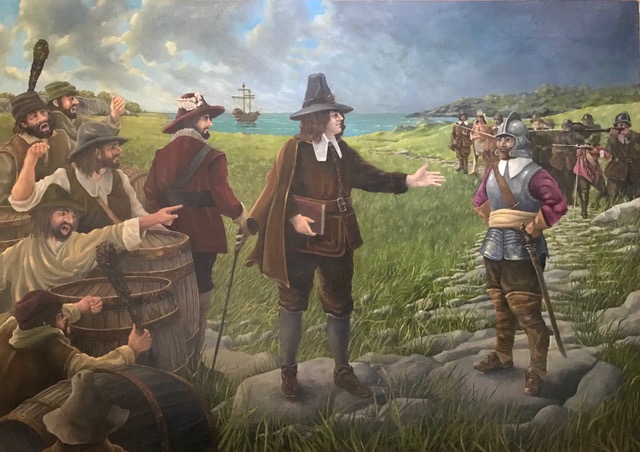
‘Blessed are the Peacemakers’ commemorates the events of 1625 when Roger Conant intervened in the dispute between Cape Ann fishermen and Myles Standish, military officer of the Plymouth Pilgrims. 

‘Visitors will be streaming through our church,’ says Diane Smith, Chair of its Archives committee. She tells me that displaying a copy of John Washington’s painting during the 2022 Ancestry Days event will work nicely with the genealogy chart that she has for the Conant family.

Members of many other families apart from Conants will be celebrating their ancestral and immigrant connections to Salem at this 2022 event. ‘The weekend will feature lectures, tours, research opportunities, and information on the people who connect us all to Salem,’ say the organisers. But the descendants of Roger Conant will be particularly interested in the First Church display.


When Frederick Odell Conant published his History and genealogy of the Conant family in England and America in 1887 4,300 of them were listed in the book. There must be many more than that number today. I’m sure that they will be fascinated by John Washington’s portrayal of their distinguished ancestor if they are able to attend the Salem Ancestry Days event.  

Sunday, November 8, 2020

41. Blessed are the Peacemakers


This is the final version of Budleigh artist John Washington’s painting. I have lots of thoughts about it. But the outstanding thought that I have today, Remembrance Sunday, 8 November 2020, is ‘Blessed are the Peacemakers’. 

I hope that John’s painting will inspire millions of people everywhere, in the knowledge that Roger Conant, born just over 400 years ago in the same Devon village as Sir Walter Raleigh, was a worthy and respected man. 

At that critical moment in 1625, he helped to avoid conflict and divisiveness among the early European settlers in the New World.

Saturday, October 3, 2020

38. Fine detail on the Fishermen


An update from Budleigh artist John Washington for Conant 400 group members which will be of special interest both to British Devonians with links to East Budleigh and American residents of Gloucester, Massachusetts. 

John is continuing to work on his painting of the celebrated 1625 scene at Fishermen’s Field. That was when Roger Conant intervened and avoided possible bloodshed in the confrontation between fishermen from England’s West Country, led by John Hewes, and Captain Miles Standish, military adviser to the Plymouth Pilgrims:

‘I thought you might like to see the fishermen who now have their characters more clearly identified in their faces. Also, I’ve brought more detail into Tablet Rock at the back as that is such a well known landmark in the context of the story.

Next on the left hand side of the painting is to work on the hogshead salt barrels to bring them into line with the rest of the painting - more paint, more colour, more depth.’


Thursday, August 13, 2020

35. Unsettling statues: why a painting was chosen for Roger Conant’s birthplace of East Budleigh


The statue of Roger Conant, by sculptor Henry Kitson, completed in 1911, stands outside Salem’s Witch Museum.    Photo credit: John Andrews

It’s been a tough time for statues, especially in 2020. Many of them must be wondering whose turn it will be next, to be unceremoniously toppled from their plinth.  

But a year or so ago, a group of East Budleigh residents decided that they wanted to honour Roger Conant, the mill owner’s son who left England in 1623 to found the city of Salem.


How the Conant family mill in East Budleigh, sadly demolished in the early 20th century,  might have looked. Frontispiece illustration from Upper Canada Sketches by Thomas Conant, Toronto: William Briggs 1898

And a mini version of Salem’s statue, perhaps located near the Conant family mill, seemed an obvious tribute.  


The unveiling of the statue of Sir Walter Raleigh in East Budleigh, 7 February 2006. L-r: HRH The Duke of Kent, East Budleigh Parish Chairman Steve Baker, Hugo Swire MP, the sculptor Vivien Mallock FRBS

However even a small statue would have been expensive. The above statue of Sir Walter Raleigh was famously financed by British American Tobacco. And that source of funding, as you can imagine, was controversial. The charity Action on Smoking and Health even called it ‘a cynical publicity stunt’ by the company.    


Detail of Henry Kitson's statue of Roger Conant as seen at

Further research into Roger Conant’s life has revealed a man whose character was somewhat different from the impression given by the Salem statue with — in descendant Jeff Conant’s words — its ‘stern wind-burned face’.


The American lawyer and historian John Wingate Thornton (1818-78). His book The Landing at Cape Anne or The Charter of the first permanent colony on the territory of the Massachusetts Company was published in 1854  

Biographers have written of Conant’s attitude of tolerance and conciliation, of his self-effacing but meticulously honest character and of his mild and moderate views: he was, wrote John Wingate Thornton, quiet, unobtrusive and unambitious, ‘preferring the public good to his private interests’.


Portrait of Sir Walter Raleigh in All Saints’ Church, East Budleigh. It shows Raleigh in court dress at the height of his favour with Queen Elizabeth I.  

Rather different in character from the flamboyant and ambitious Sir Walter Raleigh!
  
As in Europe, the nineteenth century saw a proliferation of imposing statues in American towns and cities.

In some cases, nationalistic pride was allied to a moral crusade, clearly inspired by reverence towards people seen as the nation’s Puritan Founding Fathers.


Portrait of Nathaniel Hawthorne 1804-64 by Charles Osgood

A minority took a different view. Author Nathaniel Hawthorne, for example, wrote of his Puritan ancestors as ‘stern and black-browed’ members of ‘the most intolerant brood that ever lived’.


This statue, ‘The Puritan’ created by the American sculptor Augustus St Gaudens (1848-1907) and unveiled in 1887, stands in Springfield, Massachusetts. I’m not the only one to be struck by its grim face: art historian Dr Dianne Durante describes it as ‘a figure of authority, somewhere between militant and menacing’.       


Here is a later 1904 version of the same figure sculpted by St Gaudens, this time entitled ‘The Pilgrim’ and carrying a clearly labelled Bible. It stands in Philadelphia, and I find the face just as unappealing as the earlier ‘Puritan’!   

The sternness of the Salem statue’s facial features has inspired an interesting view of why and how it was erected in the city so closely associated with Conant.  

The sculptor, it seems, according to Professor Joseph Conforti, was sending a conservative message to Salem residents at a critical time in the city’s history during the early 20th century.     

‘Labor unrest provoked fears of mounting violence and radical political protest’, he explains in his book Imagining New England: Explorations of Regional Identity from the Pilgrims to the Mid-Twentieth Century, published by the University of North Carolina Press in 2001.     


Anglo-American sculptor Henry Hudson Kitson (c.1864-1947)  Photo by J.P. Purdy in Henry Hudson and Theo Alice Ruggles Kitson papers, Archives of American Art, Smithsonian Institution

‘Amid a rising tide of immigrants and growing alarm over labor unrest, a new monument to Salem’s past was erected — a grand human figure that, in Professor Conforti’s words, ‘hovered like a moral sentry over Salem’s changed social  order’. 

‘In 1911, noted sculptor Henry Kitson  completed a statue of Roger Conant, the first  permanent settler in Salem. Situated next to the common in the center of the city, the magnificent figure rivaled Saint-Gaudens’s statue of The Puritan, to which it bears a striking resemblance. Bestride an eight-foot boulder, the stern, manly Conant towered over pedestrians’.  

In Professor Conforti’s view, Kitson’s sculpture had a political purpose. It ‘served to inspire the native-born minority and to encourage respect for Salem’s heritage among the city’s immigrant throng.’


The idea of a painting by Budleigh artist John Washington was chosen as a tribute to Roger Conant rather than a statue. 

John’s painting, still a work in progress, focuses on the famous 1625 incident at Fishermen’s Field on Cape Ann, near the city of Gloucester in Massachusetts. It is there that Roger Conant is recorded as having averted a bloody confrontation between two groups of settlers.

You can follow John’s progress on the project at  https://www.johnwashingtonartist.com/blog.html

The artist’s portrayal of Conant the Peacemaker will strike, it is hoped, a completely different note from Kitson’s statue, and one that is more in keeping with what we know of the character of Salem’s founder.  There is, sadly, no portrait of Roger Conant in existence.

And of course, thanks to John’s generosity, East Budleigh’s Conant 400 Group has not had to appeal again to a company like British American Tobacco.


Friday, July 10, 2020

34. Conant at Cape Ann: a painting’s progress online


I’m not the only blogger in Budleigh Salterton!

And not the only one blogging about Roger Conant.

Local artist John Washington, Chair of our town’s Art Club, has thrown himself enthusiastically into the project of an exciting ‘history painting’.

Two years ago, John organized a successful re-enactment of the scene in 1870 when the celebrated Pre-Raphaelite artist Sir John Everett Millais stayed in Budleigh Salterton and started work on his masterpiece ‘The Boyhood of Raleigh’.

Set on our pebble beach, the painting shows an imagined scene where young Walter Raleigh and his half-brother Humphrey Gilbert are inspired by the stories of travel and adventure told to them by a local sailor. John, in costume as Millais, is pictured above.

John’s current work focuses on the famous 1625 incident at Fishermen’s Field on Cape Ann, near Gloucester MA, when Roger Conant is recorded as having averted a bloody confrontation between two groups of settlers.

‘A degree of artistic license will be required but I still intend to include as much historical accuracy as possible,’ says John.

You can follow John’s progress on the project at  https://www.johnwashingtonartist.com/blog.html


You can access other posts on this blog by going to the Blog Archive (under the ‘About Me’ section), and clicking on the appropriate heading.


Tuesday, June 16, 2020

32. History in art: Arms and the Men

Continued from   https://conant400.blogspot.com/2020/06/painting-from-history-two-artists-at.html


Budleigh resident Nick Speare as The Sailor in the 2018 ‘The Boyhood of Raleigh’ re-enactment by Fairlynch Museum volunteers. Photo credit: Rob Coombe   

Still remembering that swelteringly hot day in May 2018 when we re-enacted ‘The Boyhood of Raleigh’ on Budleigh beach, I’m continuing to relate John Washington’s sketch to Millais’ masterpiece.


Young Walter as portrayed in Millais’ The Boyhood of Raleigh

As Millais and every artist knows, hand and arm gestures play a key role in their work, guiding the viewer to a certain conclusion. Young Walter’s gaze is internalised, fixed on the world of his imagination, thousands of miles distant from what we actually see in the painting. He seems to be looking through the sailor rather than at him.


The Boyhood of Raleigh, on show for the third time at Budleigh Salterton’s Fairlynch Museum, on loan from Tate Britain

The sailor’s words and above all that outstretched arm were the stimulus for that imagination. Now, in turn, it takes ‘The Boyhood’s’ Victorian audience beyond the horizon to inspire them – and particularly young boys – with thoughts of creating an even greater British Empire. 

‘The sailor’s arm points into the distance, taking the eye out of the main frame and implying a world of romantic adventure beyond its confines,’ comments Professor Linda Dryden in her book about the novelist Joseph Conrad.


In John Washington’s sketch, above, depicting a celebrated incident on Fishermen’s Field at Cape Ann, near Gloucester MA, Roger Conant is the central figure. 

To his right is Captain John Hewes, who had been sent with sailors and fishermen by West Country investors in an attempt to claim abandoned assets of the bankrupt Dorchester Company, especially the barrels of salt, an expensive commodity. 

To Conant’s left is the diminutive Captain Miles Standish - rudely named 'Captain Shrimp' by his enemies - and a troop of armed marines who had been sent by Governor Bradford from the Plymouth Colony to protect what it saw as its assets. 


Conant’s arm, the palm of his hand open in sign of friendship, keeps the viewer firmly within the frame and focused on the smiling central figure. I notice that it’s his left hand that he extends to Standish. Was he left-handed? Who knows. 

His right hand firmly clasps a book. Perhaps it’s a folder of legal documents which he has consulted. As Gloucester historian Mary Ellen Lepionka explains, ‘According to accounts of the 1625 confrontation, Hewes and his men barricaded themselves behind barrels of salt in the flake yard and Standish threatened to open fire on them, when Roger Conant and company “rushed from their huts” (modified wigwams with chimneys instead of smoke hole) to explain that by English law everything in Fishermen’s Field was still Dorchester Company property pending the outcome of bankruptcy proceedings’.


The statue of Roger Conant outside the Witch Museum, Salem, Massachusetts
Photo credit: Kate Fox

Smiling in contrast with the rather grim-faced statue of Roger Conant that is one of Salem’s landmarks.

The sketch marks a crucial point in time and hints at a few seconds of suspense. Conant’s gesture is open and friendly, but Standish has not responded. He looks nonplussed. His background is military and he is a man of action. Will he give the order to the heavily armed soldiers behind him to open fire on the fishermen and sailors? The latter’s gestures – clenched fists and pointing fingers – are openly defiant and hostile.


An artist’s image of Captain Miles Standish from The Courtship of Miles Standish, an 1858 narrative poem by American poet Henry Wadsworth Longfellow.  The American artist N.C. Wyeth was known for his illustrations of The Last of the Mohicans (1826) and Treasure Island (1883).

How will the situation be resolved? This moment could easily have been the start of an early civil war between white settlers in America? By 1625, when the incident took place, Captain Miles Standish, one of the most prominent in the group of Plymouth Puritan separatists who had sailed on the Mayflower, had proved that he was capable of extreme violence.

Continued at https://conant400.blogspot.com/2020/06/33-kind-of-ruffling-course-in-world.html


You can access other posts on this blog by going to the Blog Archive (under the ‘About Me’ section), and clicking on the appropriate heading.