Friday, November 22, 2019

11. Coming Home to Budleigh: Jeff Conant's 2016 visit to his old village home (2) - some photos


During his visit to East Budleigh in 2016 Jeff saw the millstone from the village mill which his ancestors owned five centuries ago.  The Conant stone is outside the Church Hall, overlooking the village car park on Hayes Lane. . 


A must-see in East Budleigh is All Saints Church, where the families of Sir Walter Raleigh and Roger Conant worshipped. Both Sir Walter's and Roger's fathers were churchwardens. The church's 16th century carved oak bench ends are famous. 


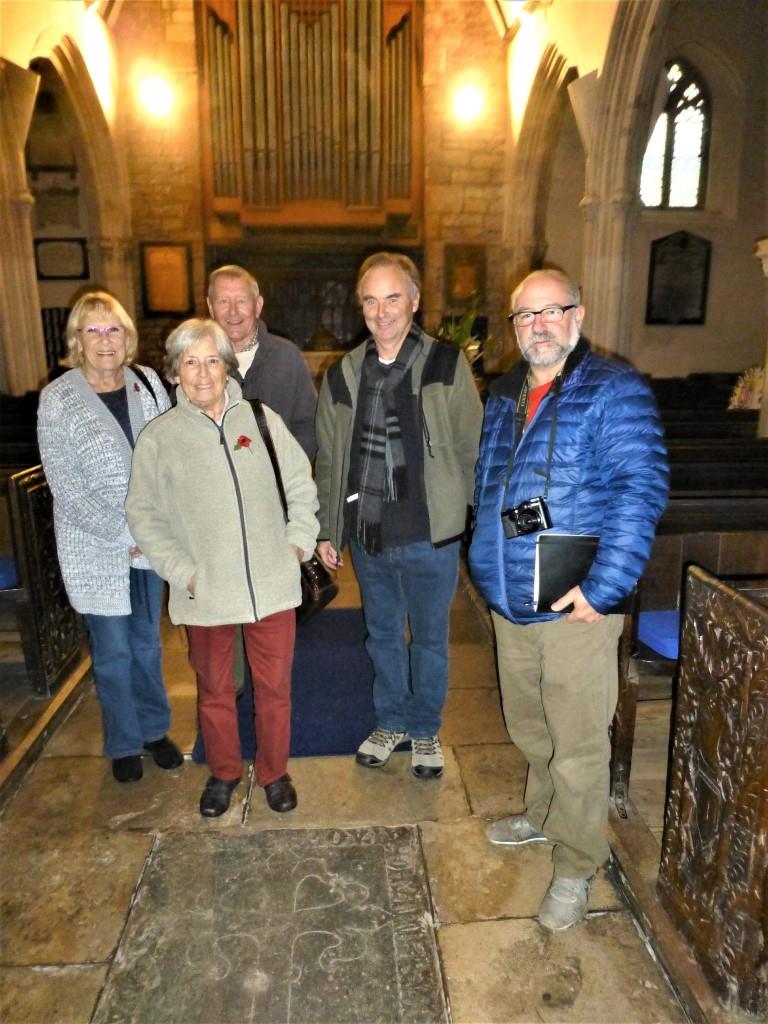
Jeff's guides during his tour of the village were l-r: Trevor Waddington (Chairman of Fairlynch Museum), local resident and All Saints Church expert Hanneke Coates, Roz Hickman (Head of Local History at Fairlynch Museum) and Anthea Downes (museum volunteer)


The Conant family pew at All Saints Church. 


In All Saints Church, looking at the nave where Sir Walter Raleigh's stepmother Joan Drake is buried.


Jeff enjoyed meeting Hanneke Coates and hearing her stories of All Saints Church and the village where she has lived for many years. 

There are many more photos - much finer than mine -  taken by Jeff during his few days in the Budleigh area. You can see them at https://qq0u.app.link/e/DIObyp1GNR

Continued at https://conant400.blogspot.com/2019/11/coming-home-to-budleigh-jeff-conants_24.html

You can access other posts on this blog by going to the Blog Archive (under the ‘About Me’ section), and clicking on the appropriate heading.

Wednesday, November 20, 2019

10. Coming Home to Budleigh: Jeff Conant's 2016 visit to his old village home (1) - About Jeff


Jeff contemplates the Conant millstone outside the Church Hall in East Budleigh. It's all that's left of the village mill that his family owned more than four hundred years ago. 

Following on from from the article by David Daniel about Jeff Conant's visit to East Budleigh in 2016 at 
https://conant400.blogspot.com/2019/11/why-did-jeff-conant-fly-5286-miles-from.html
you can read more about about Jeff below. 

I reckon that we'll be seeing many more descendants of Roger Conant in East Devon as we approach the 400th anniversary of the city that he founded in 1626. 

Just a glance at the title of this 640-page book published in 1887 is enough to tell you that there are many of them, both across the Atlantic and here in Britain. The author was Frederick Odell Conant MA  of Portland, Maine, and the full title is 'A History and Genealogy of the Conant Family in England and America, Thirteen Generations, 1520-1887, containing also some genealogical notes on the Connet, Connett and Connit Families'. You can read it online at https://archive.org/details/historygenealogy00cona/page/n4


It was the Conant Family Association which approved sculptor Henry Kitson's design for the bronze statue of their famous ancestor.  It stands outside the Witch Museum in Salem MA, giving the unfortunate impression that Roger Conant dabbled in the black arts. Nothing could be further from the truth. 

Image credit: Rick Parrott II


Back to his descendant Jeff. In a future post you can see more photos of his time in the East Budleigh area, and read his own beautifully written account of his visit, including his 'meeting' with the Salem statue:  


Jeff Conant is a writer, educator, and social justice activist with a focus on international development and ecology. 

He graduated with a BA in Anthropology and American Literature from Boston University, Massachusetts, in 1989, later gaining an MA in Writing and Poetics from New College of California in 1995.  


Jeff directs the international forests program with Friends of the Earth US, which protects forests and the rights of forest-dependent peoples. He manages a team of campaigners working to pressure the world's largest banks, investment firms, and companies to go deforestation-free.


Previously Jeff worked with Global Justice Ecology Project where he advocated for climate justice at the U.N. and other global arenas.


As a researcher and independent journalist he has published articles and contributed to reports on water privatization, resource colonization, food sovereignty, ecological sanitation, environmental injustice, and related issues. 

With International Accountability Project he co-authored a Community Guide to the Environmental and Social Safeguards of the Asian Development Bank; and with Hesperian Health Guides he co-authored A Community Guide to Environmental Health (2008), a grassroots manual published in over a dozen languages.

Jeff is also author of A Poetics of Resistance: the Revolutionary Public Relations of the Zapatista Insurgency (AK Press, 2010), which examines the cultural politics of the Zapatista movement of Chiapas, Mexico. It focuses on the Zapatistas' persuasive use of symbolic language and colourful imagery to bring their struggle to the world's attention. 

The book grew out of the three years from 1995-1998 that he spent as co-founder and organiser of an independent collective in Chiapas, developing potable drinking water systems, supporting autonomous agricultural development, and monitoring human rights violations in rural villages.

His translation of Wind in the Blood: Mayan Healing and Chinese Medicine (1999) is a manual for health workers in Mayan areas to bridge the gulf between Western medical technique and Mayan medical knowledge. 

His volume of poetry, The Evacuated Forest Papers, was published by Buck Downs Books in 1996.

In his spare time he writes, raises bees, chickens and vegetables, and enjoys biking, cooking, and art of all sorts.

Continued at 
https://conant400.blogspot.com/2019/11/coming-home-to-budleigh-jeff-conants.html


You can access other posts on this blog by going to the Blog Archive (under the ‘About Me’ section), and clicking on the appropriate heading.


Tuesday, November 12, 2019

9. Why did Jeff Conant fly 5,286 miles from Berkeley, CA. to visit us last month?


Hands across the Pond: Jeff Conant, a descendant of Roger Conant, founder of the American city of Salem MA, contemplates his family's ancient millstone during his 2016 visit to the UK. It's all that remains of the Mill House, East Budleigh 

This article by David Daniel, History Coordinator for the Otter Valley Association, was published in the OVA Newsletter, January 2017.   

Sir Walter Raleigh is well known but few outside East Budleigh may know of his contemporary, Roger Conant. Roger was born in the Mill House, East Budleigh, on 9th April 1592 (since demolished but just above Hill Farm). He was the youngest son of Richard Conant, miller, who had married into one of the leading merchant families of Colyton. Bother Roger’s and Walter’s fathers were Church Wardens and both families have their crests carved on bench ends in All Saints’ Church.

As the youngest son of a family of eight, Roger couldn’t expect a share of his father’s estate. In 1610, or soon after, Richard followed his brother Christopher to London. Christopher became a member of the Grocers’ Guild and merchant. Roger became a salter, a trade concerned with preserving meat and fish, not to be confused with salt production. By 1618, the year Sir Walter was beheaded, Roger was well enough established to marry Sarah Horton in Blackfriars. Having lost their first child in 1619, their second child, Caleb, was born in May 1622.

So why did Roger, with his wife and baby son, set sail for New England in 1623 and eventually become the founder of Salem, Massachusetts?

Religious, political and trading conditions were changing adversely under James I. Roger was a puritan by inclination, as were some of his ordained brothers, though not a separatist (or dissenter). In 1622 three influential sermons on the subject of colonization were published. The plantation colonies of: Jamestown, Virginia (1607); and Plymouth, New England (1620) were beginning to succeed. The Plymouth Colony was well placed to supplement the century old cod fishing industry that Merchant Venturers were keen on extending throughout the year, providing opportunities for a salter. Forty vessels sailed to New England in 1623, the Conant family in one of them.

They spent their first year in the Plymouth Colony founded by pilgrim separatists who originated from Nottinghamshire but became disillusioned by the factions within the community. After a year in more congenial company in Boston Bay they moved northward to Cape Anne where Roger became the manager of the “fishing plantation” set up on speculation by “The Dorchester Company”. This Company failed and when the next boat arrived from England, Roger learned that a new Company had taken over. He was offered free passage home but instead led a small group of seasoned settlers to an abandoned Native American settlement, Naumkeag. Further funds and provisions were raised in England and in a 1626 Thanksgiving Ceremony it was renamed Salem. Roger's leadership provided the stability to survive the first two years, but he was replaced as Governor in 1628 by John Endecott, one of the new arrivals at the start of the mass migration, by order of the Massachusetts Bay Company.

From time to time descendants of Roger and Sarah Conant visit East Budleigh. Jeff (pictured) is the latest. He stayed at the King’s Arms, Otterton; took part in a quiz night; was shown around East Budleigh by members of the OVA and Fairlynch Museum; and enjoyed some hospitality in the Sir Walter Raleigh. Jeff is the Forestry Programme manager for Friends of the Earth and already knew all about our Beavers!

(Main history source: Roger Conant, A Founder of Massachusetts, by Clifford K. Shipton, © 1944, Harvard College, USA)
Article reproduced courtesy of the Otter Valley Association www.ova.org.uk 

You can access other posts on this blog by going to the Blog Archive (under the ‘About Me’ section), and clicking on the appropriate heading.

Sunday, November 10, 2019

8. Some Grave Matters


East Budleigh’s All Saints, where both Sir Walter Raleigh’s and Roger Conant’s families worshipped, is celebrated as an ancient church, famous for its magnificent carved oak bench ends dating back to Tudor times.

But if you have time, during your visit to this beautiful historic building, you may like to take a wander in the churchyard, if only because it’s distinguished in its own way. In 2019 it was crowned the best churchyard in Devon in a competition organised by the Campaign to Protect Rural England.


A view of the churchyard from the tower

‘Devon’s churchyards are so much more than burial grounds,’ say the CPRE, which staged the first competition in 2018. ‘They are unique and special places. Green havens of sanctuary for people and wildlife. Some little changed over the centuries.’  

East Budleigh’s church won the CPRE competition on the basis of what was described as its ‘maintenance, planting and habitat management.’  An additional criterion, though it’s not mentioned, is the number of graves in All Saints churchyard which commemorate a fascinating range of historically important people - not all of them Devonians of course.  


My friend Prof Brent Lane at the resting place of Raleigh's grave during a visit to London in 2015

You won’t find Sir Walter Raleigh’s grave here – he’s buried in the church of St Margaret’s Westminster, in London. And sadly, no one seems to know the location of Roger Conant’s grave. His suspected burial place is Burying Point Cemetery in Salem MA, but it has never been determined with certainty.

However at least two graves of other people from the past buried in All Saints churchyard will have special interest for visitors from across the Atlantic.


Taking them in chronological order I found the last resting place of the retired wealthy London bookseller James Lackington (1746-1815). It's easy to discover, at the beginning of the path leading to the church.


The Rev Jonathan Froggatt, Minister of the Temple Methodist Church in Budleigh Salterton, and Cllr Christine Channon officiated at the unveiling of the blue plaque 

James Lackington was such a character that he well deserved the blue plaque set up in his honour in 2017 on the site of the Temple Church in Budleigh Salterton.  I’ve written about him elsewhere at http://budleighbrewsterunited.blogspot.com/2009/08/temple-is-apt-setting-for-literary.html


The grave of Baldwin Francis Duppa FRS in All Saints churchyard

Baldwin Francis Duppa (1828-1873), a distinguished chemist, was one of two Fellows of the Royal Society associated with the Budleigh area.  There is an excellent article about him by Dr Roger Lendon at http://www.ovapedia.org.uk/index.php?page=Two-Scientists-Duppa-Baldwin-Francis-Warington-Robert-Budleigh-Salterton-C19


Dr Lendon does not mention Baldwin Francis Duppa’s younger brother, Phillip Darrell Duppa (1832-92), who has no real connection with East Devon, and is certainly not buried at All Saints. But Duppa’s name may be familiar to residents of the state of Arizona because he is regarded as the founder of the city of Phoenix.

Indeed he seems to be revered there as much as Roger Conant is in Salem MA. ‘The legend of “Lord Duppa” lives on’ are the words on the gravestone of this ‘English Gentleman’ in Phoenix’s Pioneer and Military Memorial Park. 


The Preedy Window in All Saints Church: the inscription reads 'In memory of Vice-Admiral George William Preedy CB, who, when Captain of HMS Agamemnon with the Captain of the USS Niagara successfully laid the first Atlantic Cable uniting Europe and America in 1858'  

Back in All Saints churchyard you can find the grave of a courageous officer in Queen Victoria’s navy who is distinguished for helping to forge a historic link between Britain and the United States. This fine stained glass window commemorates the achievement of Admiral George William Preedy CB (1817-94) described in the above inscription.


The grave of Admiral Preedy and his wife
Photo by Trevor Waddington

I wrote about the event some ten years ago at http://budleighbrewsterunited.blogspot.com/2009/07/another-link-across-pond.html  Visitors to Fairlynch Museum were suitably impressed by an exhibition in 2017 to mark the bicentenary of the Admiral’s birth.


Baldwin Francis Duppa’s grave is also the resting place of his wife, born Adeline Frances Mary Dart (1845-95). She is known as a botanical artist with a meticulous eye for detail; under her married name she has drawings in London’s Natural History Museum of Italian and Madeira plants and English fungi, which are included in the ‘Dictionary of British and Irish Botanists and Horticulturalists’. Shown above is one of her delicate and skilful drawings which depicted the Budleigh area.


The grave of Henry John Carter FRS.  His biography was written to coincide with Fairlynch Museum's 2013 exhibition 'Sea, Salt and Sponges' 

A second Fellow of the Royal Society died and was buried at All Saints in 1895. This was the surgeon, geologist and marine sponge expert Henry Carter FRS, whose name is still revered by biologists worldwide. Such was his reputation among scientists of the time that the entire collection of marine sponges of the British Museum was transported from London to Exeter by rail; it was then brought to his home, ‘The Cottage’, in Budleigh Salterton, to be examined and catalogued. I was so impressed that I wrote his biography, discovering that twenty sponge species are named after him.  


The Tanqueray family grave, and some of the drinks for which the name is celebrated

Speaking of names, if you are a gin drinker you may be surprised to find the family grave of the Tanqueray family in the churchyard. Charles Henry Drought Tanqueray (1875-1928), born in East Budleigh, was the grandson of Charles Tanqueray, founder of the original London Dry Gin which bears his name.  

The year 1898 saw a merger with another well known name in the gin business and Charles Henry Drought Tanqueray was appointed  Company Secretary. He married a local girl, the East Budleigh vicar’s daughter Stella Green.


The grave of Victor Vaughan Reynolds Geraint Clinton Clinton-Baddeley - to give him his full name as inscribed - and that of his mother, Mary Constance Enid Clinton Goullet

And finally there’s the grave of the actor, author and historian who wrote under the name of V.C. Clinton-Baddeley (1900-70), and to whose book ‘Devon’ I refer elsewhere in this blog. 


He was deeply attached to the local area; one of the five detective novels that he published, ‘No Case for the Police’, published in 1970, is evidently set in Budleigh Salterton, which he calls ‘Tidwell St Peter’s’.

There are probably other graves of equally interesting individuals buried in All Saints churchyard, and I would be pleased to include them if you point them out to me.

You can access other posts on this blog by going to the Blog Archive (under the ‘About Me’ section), and clicking on the appropriate heading.


Thursday, October 31, 2019

7. Bewitched in East Budleigh! (3)

Continued from  
https://conant400.blogspot.com/2019/10/bewitched-in-east-budleigh-2.html


Top: The 1840 sign marking the foundation of a National School in Colaton Raleigh; the attractive-looking Drake’s School in nearby East Budleigh was built in 1860, though the first teacher was appointed in 1851

The village of Colaton Raleigh may have had a school as early as 1840 but overcoming countryside traditions such as belief in witchcraft through education was not achieved overnight.  

Credulity and prejudice continued to plague society, especially single women.  The Exeter and Plymouth Gazette of 24 April 1852 reported that Susannah Sellick, a 70-year-old widow from Colaton Raleigh, was accused of witchcraft and attacked by Mary Pile and Walter Gooding from the neighbouring village of East Budleigh.

In the subsequent investigation it was revealed that Gooding had attempted to drive a nail into the ground where Susannah was standing in the belief that this would break her power. Mary Pile explained to the court that she needed to draw blood from the ‘witch’ who had cast a spell on her 20-year-old daughter Amy.

The couple were fined, the magistrates complaining that this was the third case in as many months where elderly women unjustly accused of witchcraft had been assaulted. 

Dark reputations were made by such accusations. Eight years later, poor Susannah was attacked again in a case reported in the Taunton Courier and Western Advertiser of 18 July 1860.  This time she complained that a lace-maker, Virginia Ebdon, had maliciously assaulted her in Colaton Raleigh, drawing blood. Susannah’s version of events was again accepted by the court and her assailant was fined.


The Church of St John the Baptist, Colaton Raleigh 

No further attacks on her were reported and she lived to the great age of 96, being buried at Colaton Raleigh on 23 March 1879.

The case of Susannah Sellick was revealed in great detail in Willow Winsham’s  book Accused: British Witches Throughout History published by Pen & Sword Books Ltd in 2016. You can read a version of the case at http://winsham.blogspot.com/2014/12/


St Michael's Church, Otterton 

A similar case at around the same time of a woman from the  neighbouring village of Otterton is quoted by Owen Davies in his book Witchcraft, Magic and Culture 1736-1951, published by Manchester University Press in 1999. 


Sadly, the East Budleigh mill where Roger Conant was born is no more. But in the nearby village of Otterton the Mill, pictured above, still grinds corn and is open to visitors. A watermill was recorded in this locality in Domesday Book in 1068 AD 

In 1858 the elderly and 'half-witted' Mary Ford from Otterton was inevitably blamed when a young man and his future bride were taken with fits. Friends of the couple attacked Mary, leaving her with stab wounds; a subsequent investigation by the authorities led nowhere as nobody came forward to denounce the criminals. All believed that Mary was guilty of witchcraft.


This map, taken from Eric Delderfield's book 'The Raleigh Country' shows the area in which Roger Conant was brought up. The villages of East Budleigh, Otterton and Colaton Raleigh can be seen on the right, as can Budleigh Salterton - generally known in past times as Salterton

Small wonder that the Exeter and Plymouth Gazette’s  account ended with a lamentation that witchcraft is very prevalent amongst the illiterate in the Colaton, Salterton and Woodbury area.

And today? After all you’ve read you’d be forgiven for thinking that Roger Conant country is still rife with spells and pagan rituals.

Of course it’s not.


A sextet of scarecrows at East Budleigh's festival

The village does have a scarecrow festival of course. I was tempted to draw an admittedly uneasy parallel between this and Thomas Hardy’s portrait of the reddleman on Egdon Heath in The Return of the Native – a diabolical figure, his clothing and flesh saturated with the red dye that he sold as redding for the sheep grazing beyond the heath, and, in Prof Tilley’s words ‘a traditional bogeyman for children’.

But it seems that the notion of the scarecrow as some kind of pagan manifestation, a survival of ancient pre-Christian fertility customs, is a modern myth. 

‘There is insufficient evidence to suggest that scarecrows were anything other than a useful measure to control animal pests in an agricultural setting, although many of them no doubt ended up on end-of season bonfires,’ writes Cardiff University’s Dr Juliette Wood in an online article ‘The Great Scarecrow in Days Long Ago: Gothic Myth and Family Festival’ https://www.juliettewood.com/papers/scarecrow.pdf


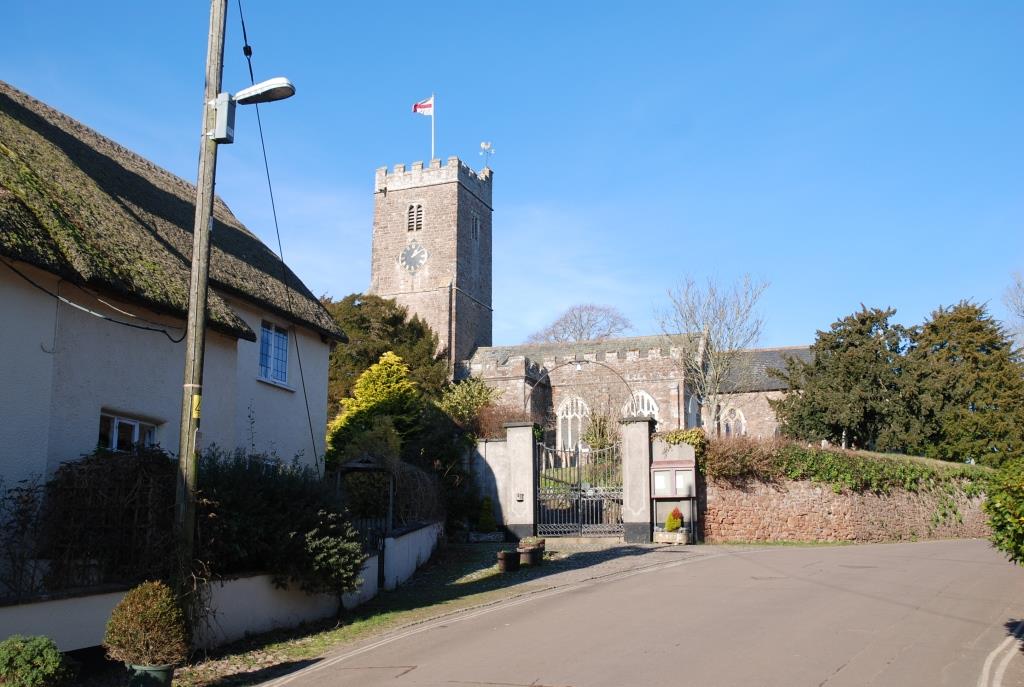
East Budleigh's All Saints Church, where the Conant - and the Raleigh families - worshipped.  Image credit: Peter Bowler  

In any case East Budleigh’s Scarecrow Festival is organised by the Friends of All Saints Church.


Ironically, it’s in this ancient church that you find the above relic  which has clear pre-Christian associations. The corbel of the central pier of the northern arcade is carved with a ‘Green Man’ motif below a cornice of four-leaf decoration. The National Churches Trust comments that the motif is one of the most powerful and enduring pagan symbols and was originally a Celtic fertility symbol.


A trio of bench ends in All Saints Church, East Budleigh.
Is the figure on the left really depicting the punishment of a tale-bearer? It has been described as eating a banana!  
Why and when was the central bench end bearing the Raleigh arms defaced? Did the image of the ship really inspire young Walter Raleigh with his overseas exploration?

All Saints Church is celebrated for its 60 carved oak Tudor bench ends, dated 1537. Some of them raise interesting questions.  You can read in detail about them at


The bench end pictured above possibly depicts a second ‘Green Man’ much admired by visitors. Writing his 2010 article for the Otter Valley Association, David Jenkinson described the carvers as influenced by the threatening mythical creatures of the Dark Ages, including such examples as the wodewose and boggarts or malevolent spirits of the fields.  

Others, like Budleigh Salterton’s eminent Dr T.N. Brushfield, in his 1892 study of the Church of All Saints, noted that the figure ‘bears some resemblance to, and has been called, the decorated head of an Indian.’

‘It’s hard not to think “Red Indian!” writes Hilary Bradt, the Devon-based founder of the Bradt Travel Guides, seeing the figure on the bench end as wearing what seems to be a feathered headdress.

‘A sailor returning from the New World would have remembered the more flamboyant aspects and perhaps described them to local craftsmen,’ she suggests.

‘But the “feathers” could also be foliage,’ she admits in deference to followers of the ‘Green Man’ theory.


Yettington resident Hanneke Coates, who contributed to a guide to All Saints Church, definitely shares the view that the bench end depicts a North American Indian.  ‘That of course is completely different from what the historians write,’ she told me. ‘But I’ve spent a long time studying and drawing the bench ends and I know them intimately.’

Whichever view you favour, they both seem appropriate against the background of the links currently being forged between Roger Conant’s home village of East Budleigh and the American community of Salem in Massachusetts that he founded. 

It's known today as the Witch City.